

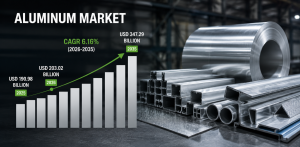
The global aluminum market was valued at USD 190.98 billion in 2025 and is projected to grow from USD 203.02 billion in 2026 to approximately USD 347.29 billion by 2035, registering a CAGR of 6.16% from 2026 to 2035. The market expansion is being fueled by the increasing demand for lightweight, durable, and recyclable materials across key industries such as automotive, aerospace, construction, packaging, and electronics.

As industries seek to improve energy efficiency and reduce emissions, aluminum has emerged as a preferred material due to its unique combination of strength, flexibility, corrosion resistance, and low weight. The growing adoption of electric vehicles, advancements in manufacturing technologies, and rising infrastructure investments are expected to further accelerate market growth over the forecast period.
Aluminum Market Size and Forecast
| Market Indicator | Value |
|---|---|
| Market Size (2025) | USD 190.98 Billion |
| Market Size (2026) | USD 203.02 Billion |
| Forecast Value (2035) | USD 347.29 Billion |
| CAGR (2026–2035) | 6.16% |
| Base Year | 2025 |
| Forecast Period | 2026–2035 |
| Largest Regional Market | Asia Pacific |
Market Highlights
Asia Pacific dominated the global aluminum market in 2025, accounting for approximately 66% of total revenue share. Among aluminum series, Series 7 is expected to witness the fastest growth, expanding at a CAGR of 7.2% through 2035, while Series 1 held nearly 20.5% of market share in 2025. By processing method, the rod and bar segment is anticipated to register a CAGR of 7.1% during the forecast period. In terms of end-use industries, the transportation segment accounted for approximately 33% of total revenue in 2025, reflecting the growing preference for lightweight materials in vehicle manufacturing.
Aluminum Market Overview
Aluminum is a silver-white, non-magnetic, and highly flexible metal that is widely recognized as one of the most abundant elements in the Earth’s crust. It possesses an exceptional combination of properties, including high strength, corrosion resistance, conductivity, and lightweight characteristics. With a density of just 2.7 g/cm³, aluminum is particularly suitable for applications where weight reduction is critical without compromising structural integrity.
The metal has become indispensable across a wide range of industries, including packaging, aerospace, construction, transportation, and electrical systems. Its non-toxic nature and ability to preserve products make it highly suitable for food packaging and pharmaceutical applications. Moreover, aluminum readily forms alloys with other elements, enabling manufacturers to tailor its properties for specialized applications such as automotive components, aircraft structures, and consumer electronics. China continues to play a vital role in global aluminum consumption, with substantial demand arising from construction, transportation, electrical infrastructure, and packaging sectors. Government initiatives aimed at enhancing industrial accessibility to aluminum have further contributed to market expansion.
Impact of Artificial Intelligence on the Aluminum Market
Artificial intelligence is increasingly transforming aluminum manufacturing by improving operational efficiency, product quality, and sustainability outcomes. AI-powered predictive maintenance systems continuously monitor equipment performance, enabling manufacturers to identify potential failures before they occur. This significantly reduces downtime while enhancing productivity.
Advanced AI algorithms are also improving quality control processes by detecting defects and ensuring compliance with strict product specifications. Through automation and intelligent energy management systems, manufacturers can optimize electricity consumption during energy-intensive production stages. Additionally, AI technologies streamline inventory management and supply chain operations, allowing producers to respond more effectively to changing market demands.
Trade Analysis of the Aluminum Market
- Global aluminum trade experienced notable growth between June 2024 and May 2025, with aluminum imports totaling approximately 65,054 shipments, reflecting robust demand from automotive, aerospace, construction, packaging, and electrical industries.
- The international trading ecosystem remained highly active, supported by 65,054 verified exporters and approximately 74,974 buyers. Overall aluminum imports increased by nearly 28%, indicating expanding industrial output and accelerating infrastructure development worldwide.
- Vietnam emerged as one of the largest aluminum consumers due to its rapidly expanding manufacturing sector. The United States also recorded strong demand, supported by automotive production, aerospace activities, beverage packaging, and renewable energy installations. Japan remained an important consumer because of its advanced automotive, electronics, and machinery industries.
- On the supply side, Vietnam, China, and the United States ranked among the leading aluminum exporters. China maintained its dominant position through extensive smelting operations, substantial manufacturing capabilities, and efficient export networks supporting global demand for semi-finished aluminum products.
Aluminum Market Growth Factors
Rising Demand from Automotive and Aerospace Industries
- The automotive and aerospace sectors continue to drive aluminum consumption due to the increasing emphasis on lightweight materials. Aluminum enables manufacturers to improve fuel efficiency, reduce emissions, and enhance overall vehicle performance. In aircraft manufacturing, its corrosion resistance and high strength-to-weight ratio make it an ideal material for structural applications.
Urbanization and Infrastructure Development
- Rapid urbanization and expanding infrastructure projects across emerging economies are creating significant demand for aluminum products. The material is extensively utilized in roofing systems, windows, door frames, staircases, curtain walls, and other construction applications because of its durability and design flexibility.
Growth in Electric Vehicle Production
- The global transition toward electric mobility is accelerating aluminum adoption. Electric vehicles require lightweight materials to maximize battery efficiency and driving range. As EV production continues to increase, aluminum demand is expected to rise substantially.
Expansion of Recycling Technologies
- Technological advancements in recycling processes have improved the availability of secondary aluminum. Recycling aluminum requires only a fraction of the energy needed to produce primary metal from bauxite, reducing environmental impact while supporting circular economy objectives.
Renewable Energy Investments
- The expansion of renewable energy infrastructure is contributing to higher aluminum consumption. Solar panel systems, wind turbines, and associated electrical equipment increasingly incorporate aluminum components due to their durability and conductivity.
Market Dynamics
Secondary Aluminum Gains Popularity
- Secondary or recycled aluminum has become an essential component of global supply due to its economic and environmental benefits. Scrap generated from beverage cans, machinery, vehicles, and industrial equipment can be reprocessed using significantly less energy than primary production.
- Investments in dismantling facilities, shredding operations, and environmentally safe recycling centers are expected to support long-term market growth. The transportation industry’s growing use of recycled aluminum is also contributing to increased consumption.
Expanding Applications Across Industries
- Aluminum’s unique physical characteristics have broadened its application base considerably. Its excellent electrical conductivity makes it suitable for long-distance power transmission systems. In aerospace, aluminum alloys such as 6061 are widely used in aircraft fuselages and wings due to their lightweight and corrosion-resistant properties.
- The material also plays an important role in refrigeration equipment, heat transfer systems, air conditioning units, and packaging applications. Its malleability enables manufacturers to create thin foils and customized designs for various industrial purposes.
Key Market Challenges
- Decarbonization remains one of the most significant challenges facing the global aluminum industry. Manufacturers are under increasing pressure to reduce emissions and adopt cleaner production technologies. Meeting sustainability targets often requires substantial investments in low-carbon technologies and renewable energy integration.
- Stringent environmental regulations present additional obstacles by increasing operational costs associated with smelting and emissions compliance. Occupational health concerns linked to prolonged exposure to aluminum dust have also prompted stricter workplace safety standards. These factors may restrict market growth to some extent during the forecast period.
Key Market Opportunities
- Aluminum’s affordability, conductivity, corrosion resistance, and lightweight characteristics continue to create substantial growth opportunities. Automotive manufacturers increasingly prefer aluminum components to improve vehicle efficiency without significantly increasing production costs.
- In response, aluminum processors are investing heavily in research and development activities aimed at creating next-generation products with enhanced performance characteristics. Continuous innovation is expected to unlock new applications and strengthen the market’s long-term growth potential.
Recent Developments in the Market
- In January 2025, Novelis renewed its multi-year partnership with thyssenkrupp Aerospace to supply aerospace-grade aluminum products, reinforcing long-term supply reliability within the aviation sector.
- In February 2026, Kazakhstan announced the launch of its first full-cycle aluminum wheel manufacturing plant in collaboration with U.S. and South Korean partners, aiming to strengthen domestic automotive production and export capabilities.
- Additionally, in September 2025, Golden Aluminum introduced its Nexcast product line in Colorado, advancing high-alloy strip casting technology to improve manufacturing efficiency and material performance.
Segment Insights
Series Insights
- Series 1 aluminum accounted for a significant share of the market in 2025 and is expected to maintain strong growth. Its widespread use in products such as aluminum foil, drawn tubes, chemical equipment, kitchenware, and household items supports sustained demand. Meanwhile, Series 7 aluminum is anticipated to expand at the fastest pace owing to its superior mechanical properties and increasing industrial applications.
Processing Method Insights
- The extrusion segment represented approximately 31.5% of market share in 2025 and is projected to witness substantial growth. Extruded aluminum products are increasingly utilized in automotive radiators, air conditioning systems, communication equipment, and specialized industrial machinery due to their versatility and structural performance.
End-Use Industry Insights
- Transportation remained the largest end-use segment in 2025, supported by growing global vehicle ownership and increased investments in mobility infrastructure. Aluminum’s lightweight nature and durability have accelerated its adoption across passenger vehicles, commercial transportation, and electric mobility solutions.
- The packaging segment is also expected to experience robust growth as food manufacturers increasingly rely on aluminum’s barrier properties to preserve freshness and extend product shelf life.
Regional Analysis
Asia Pacific Leads Global Demand
- Asia Pacific held the dominant market position in 2025 and is expected to remain the fastest-growing regional market throughout the forecast period. The regional market was valued at USD 126.05 billion in 2025 and is projected to reach approximately USD 231.41 billion by 2035, expanding at a CAGR of 6.26%.
- Rapid industrialization, expanding urban populations, infrastructure development, and strong automotive production have contributed significantly to regional growth. Major economies including China, India, and Japan continue to drive aluminum consumption across multiple industries.
- China’s aluminum output has expanded considerably due to increasing production capacity. According to official statistics, the country’s aluminum production reached 3.77 million tonnes in December 2024, supported by sustained industrial demand.
North America Demonstrates Strong Momentum
- North America accounted for a significant revenue share in 2025, driven by strong demand from automotive, aerospace, and packaging industries. The transition toward electric vehicles and sustainable manufacturing practices has accelerated aluminum adoption throughout the region.
- The United States has also benefited from rising construction activity and government initiatives supporting domestic manufacturing capabilities and supply chain resilience.
Europe Advances Through Sustainability Initiatives
- Europe is expected to witness substantial growth owing to stringent carbon reduction regulations and increasing adoption of electric vehicles. Countries such as Germany, France, and the United Kingdom continue to invest in sustainable aluminum production and recycled material solutions aligned with the European Union’s environmental objectives.
Latin America Shows Emerging Potential
- Latin America is experiencing increasing aluminum demand due to automotive industry expansion and growing exports. Countries including Brazil and Mexico are integrating lightweight materials into manufacturing operations to improve efficiency and comply with evolving emissions standards.
Middle East and Africa Present Growth Opportunities
- The Middle East and Africa region is anticipated to register steady growth supported by infrastructure investments, industrial diversification, and increasing vehicle imports. The UAE and Saudi Arabia remain key contributors, aided by government initiatives promoting sustainable industrial development.
Future Outlook
- The aluminum market is poised for sustained expansion over the coming decade, supported by growing demand from transportation, construction, renewable energy, and packaging industries. The industry’s future will increasingly depend on innovations in recycling, decarbonization, and intelligent manufacturing technologies.
- As governments strengthen environmental regulations and industries seek more sustainable material solutions, aluminum’s unique combination of lightweight performance, recyclability, and durability positions it as one of the most important industrial metals driving the global economy through 2035.
Also Read: Managed Print Services Market
Get this report to explore global market size, share, CAGR, and trends, featuring detailed segmental analysis and an insightful competitive landscape overview: https://www.precedenceresearch.com/sample/2209
You can place an order or ask any questions. Please feel free to contact us at sales@precedenceresearch.com |+1 804 441 9344