
Asia Pacific Soil Remediation Market to Reach USD 32.9 Billion by 2034, Fueled by AI, Digital Transformation, and Green Development
The Asia Pacific soil remediation market is undergoing a transformative shift as nations across the region intensify efforts to restore degraded land and combat the impacts of rapid urbanization and industrialization. Valued at USD 15.66 billion in 2024, the market is projected to reach USD 32.9 billion by 2034, expanding at a CAGR of 7.74% from 2025 to 2034, according to Precedence Research.
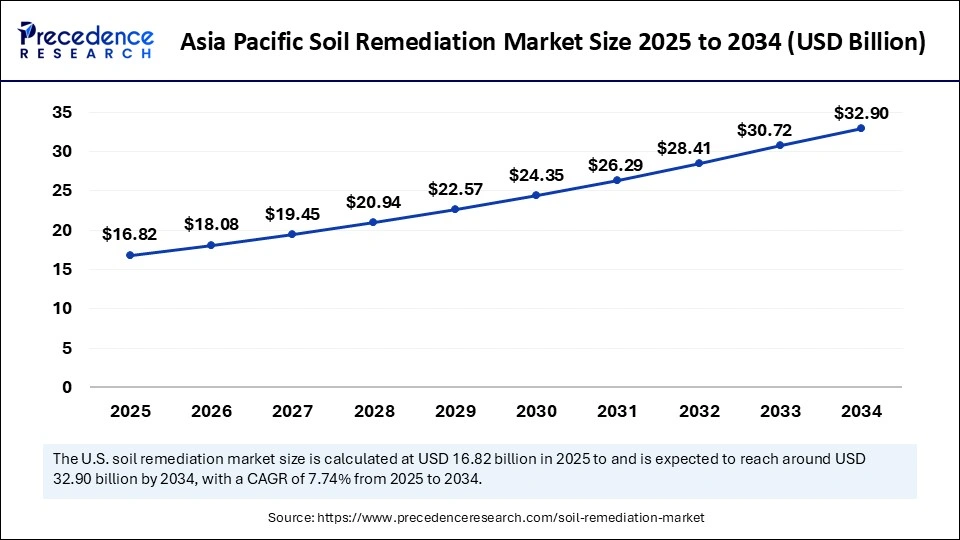
Growing awareness of soil contamination’s environmental and health risks, coupled with stricter government regulations and the urgent need to redevelop brownfield sites, is driving unprecedented momentum across the sector. Emerging technologies such as artificial intelligence (AI), precision agriculture, and digital transformation are reshaping the way stakeholders approach remediation—enabling more effective, efficient, and sustainable soil management practices.
Quick Insights
Market Size (2024): USD 15.66 Billion
Market Size (2025): USD 16.82 Billion
Market Forecast (2034): USD 32.90 Billion
CAGR (2025–2034): 7.74%
Leading Technique (2024): Chemical methods – 41.26% share
Fastest-Growing Technique (2025–2034): Biological methods – CAGR 9.48%
Top Drivers: AI integration, precision agriculture, green development, regulatory enforcement
Notable Players: Veolia Environment, SUEZ, TerraTherm (Cascade Environmental), AECOM, Clean Harbors, Bechtel, REGENESIS
Market Outlook: Where Is the Growth Coming From?
The soil remediation sector in Asia Pacific is no longer seen as a niche environmental service—it has become a cornerstone of sustainable development. Industrial expansion, mining activities, and rapid urbanization have amplified soil contamination challenges, while governments are imposing stringent mandates to accelerate cleanup efforts.
At the same time, precision agriculture and AI-powered solutions are enabling a new era of proactive land management. Farmers and environmental agencies are increasingly using real-time soil sensors, satellite imagery, and predictive models to manage soil contamination and improve remediation efficiency.
The combination of these forces positions soil remediation not only as a compliance necessity but also as a growth industry central to food security, climate resilience, and sustainable urban development.
How Is Artificial Intelligence (AI) Reshaping Soil Remediation?
AI has emerged as a powerful enabler for precision environmental management. By combining machine learning algorithms with bioremediation and monitoring systems, AI enhances pollution removal efficiency, optimizes water and nutrient management, and supports predictive modeling for long-term conservation planning.
Applications include:
Automated soil sampling and analysis
Real-time soil monitoring through IoT sensors
Predictive ecological modeling for restoration projects
Optimization of irrigation, fertilization, and pest control in agriculture
AI also plays a critical role in advancing the circular economy by reducing waste, enhancing resource utilization, and supporting low-carbon agricultural transitions.
Expert Perspective
“The Asia Pacific soil remediation market is no longer driven by regulation alone—it is now shaped by innovation. Artificial intelligence, bioremediation, and precision agriculture are converging to create a new sustainability framework. Companies that embrace this shift will not only achieve compliance but also unlock significant long-term value,”
said Dr. Ananya Mehta, Principal Consultant at Precedence Research.
Market Scope
| Report Coverage | Details |
| Market Size by 2034 | USD 32.90 Billion |
| Market Size in 2025 | USD 16.82 Billion |
| Market Size in 2024 | USD 15.66 Billion |
| Market Growth Rate from 2025 to 2034 | CAGR of 7.74% |
| Base Year | 2024 |
| Forecast Period | 2025 to 2034 |
| Segments Covered | By Technique |
Regional Insights
The Asia Pacific region, led by China, India, and Japan, is witnessing rapid adoption of soil remediation techniques due to:
China’s brownfield redevelopment initiatives to support urban expansion.
India’s agricultural modernization, including AI-driven soil health monitoring and the BRICS Land Restoration Partnership launched in April 2025.
Japan’s advanced remediation technologies, particularly chemical oxidation and thermal desorption, aligned with its strict environmental protection frameworks.
Governments across the region are increasingly collaborating with private environmental firms to accelerate cleanup timelines and align with sustainable development goals (SDGs).
What Opportunities Are Emerging in the Market?
Digital Transformation: IoT, smart meters, and AI platforms are revolutionizing remediation operations, enabling better traceability and sustainability outcomes.
Green Development: Rising consumer and regulatory preference for eco-friendly bioremediation opens opportunities for SMEs and startups.
Infrastructure Investment: Expanding transportation, industrial, and real estate projects across Asia Pacific are driving demand for remediation of brownfield and industrial sites.
Innovation in Soil Conditioners: While high costs remain a challenge, advanced nano-enhanced products are pushing the frontier of soil restoration technologies.
Industry Challenges
Despite strong growth prospects, several challenges threaten to slow adoption:
High cost of advanced soil conditioners and nano-enhanced products, limiting accessibility for small farmers.
Complexity of large-scale projects involving multiple contaminants and urban infrastructure.
Regulatory enforcement gaps in certain developing economies, leading to uneven adoption.
Latest Developments & Case Study
April 2025: BRICS nations launched the Land Restoration Partnership to combat desertification, soil fertility loss, and land degradation. India is playing a central role in aligning these efforts with its food security and urban development goals.
July 2025: Kemin Industries introduced RevoCURB, a botanical-oil-based soil treatment designed as a sustainable alternative to traditional fumigants, particularly for organic growers.
Case Study: Brownfield Redevelopment in India
A flagship brownfield redevelopment project in India showcased the integration of chemical oxidation and bioremediation techniques. Contaminated industrial land was successfully restored for agricultural use within two years, reducing heavy metal content by 78%. This case demonstrates how hybrid remediation approaches can balance speed with sustainability—providing a blueprint for urban expansion across the region.
Read Also: Powder-Bonding 3D Printing Construction Market Size, Forecast by 2034
Competitive Landscape
Leading companies in the Asia Pacific soil remediation market include:
Veolia Environment S.A.
SUEZ
TerraTherm, Inc. (Cascade Environmental)
AECOM
Jacobs Solutions Inc.
Clean Harbors, Inc.
Bechtel Corporation
REGENESIS
Dowa Ecosystem
Boskalis Environmental
Call to Action
Precedence Research offers customized market intelligence reports tailored to soil remediation stakeholders—from governments and policymakers to technology providers and investors.
👉 Download a Sample Report on the Asia Pacific Soil Remediation Market
About Precedence Research
Precedence Research is a leading global provider of strategic market insights, delivering actionable intelligence across emerging industries. Our expertise spans healthcare, technology, energy, environment, and advanced manufacturing sectors. With a strong commitment to accuracy, integrity, and innovation, we empower clients to make informed decisions in a rapidly evolving marketplace.
Contact:
Precedence Research
Email: sales@precedenceresearch.com
Phone: +1 650-460-3308
Web: www.precedenceresearch.com