

The global automotive ancillaries’ products market is projected to grow from USD 17.65 Bn in 2024 to USD 33.79 Bn by 2034, at a CAGR of 6.71%.
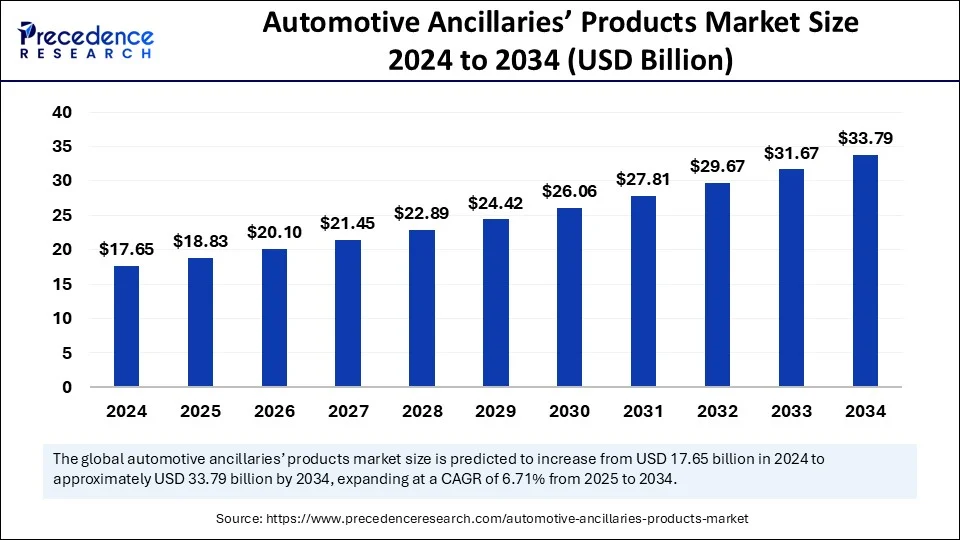

Automotive Ancillaries’ Products Market Key Takeaways
- Asia Pacific dominated the automotive ancillaries’ products market with the largest market share of 39% in 2024.
- North America is anticipated to grow at the fastest CAGR during the forecasted years.
- By component, the engine transmission and suspension components segment captured the biggest market share in 2024.
- By component, the electrical parts segment is expected to grow at the fastest rate during the forecast period.
- By application, the passenger vehicle segment held the major market share of 73% in 2024.
- By application, the commercial vehicle segment is anticipated to show considerable growth in the forecast period.
- By distribution channel, the aftermarket segment accounted for the kargest market share of 75% in 2024.
- By distribution channel, the OEM segment is anticipated to show considerable growth over the forecast period.
Market Overview
In the automotive ancillaries’ products market post-pandemic recovery has brought renewed momentum. As automotive production rebounds and supply chains stabilize, the demand for both OEM and aftermarket ancillary products has witnessed a sharp upturn. Moreover, digital disruption across manufacturing and logistics has enhanced operational efficiencies, transforming the way ancillary products are designed, manufactured, and delivered. From connected diagnostics to predictive maintenance, the digitalization of vehicle systems is accelerating innovation in the ancillaries sector, positioning it as a key enabler of smart mobility.
Drivers
The revival of global automotive production is a crucial driver for this market. With governments easing restrictions and consumers returning to personal vehicle ownership post-pandemic, component suppliers are seeing increased orders from OEMs and dealers. The surge in demand for personal vehicles has also bolstered the aftermarket segment, particularly for maintenance-related products such as filters, batteries, and brake components. Another key driver is the rapid adoption of digital manufacturing techniques, including robotics, additive manufacturing, and cloud-based production planning, which enhances the speed and precision of ancillary component development.
Opportunities
Digital transformation presents vast opportunities for automotive ancillaries’ product manufacturers. Predictive analytics, AI-powered inventory systems, and blockchain-based supply chains are optimizing production and delivery. The rise of over-the-air (OTA) updates and telematics enables manufacturers to create adaptive components that align with evolving vehicle software. Additionally, the growing demand for personalized and luxury vehicles is fueling the need for specialized ancillaries such as ambient lighting, customized interiors, and performance-enhancing accessories. The trend toward modular vehicle design also favors plug-and-play ancillary components that simplify manufacturing and maintenance.
Challenges
Despite the market’s resurgence, several challenges persist. Supply chain fragility continues to affect the timely delivery of raw materials and critical electronic components. The global shortage of semiconductors, in particular, has had a cascading impact on production timelines. Additionally, cybersecurity risks associated with connected automotive components pose a growing threat, requiring continuous investment in protection measures. The pressure to meet rising customer expectations while maintaining affordability also poses a challenge, especially in price-sensitive markets. Moreover, workforce shortages in skilled manufacturing roles may hinder production capabilities for complex components.
Regional Insights
North America is experiencing strong market recovery, aided by economic stimulus programs and increased investment in automotive innovation. The U.S. remains a key player in technological advancements and aftermarket segment growth. In Europe, the push for sustainability is driving significant investment in green and digital mobility solutions, with countries like Sweden, Norway, and the Netherlands at the forefront. The Asia-Pacific region continues to be a manufacturing powerhouse, supported by strong domestic demand and government-led industrial policies. Countries like India and Indonesia are becoming focal points for ancillary production due to favorable labor and infrastructure conditions.
Recent Developments
The automotive ancillaries’ products market has seen significant investment in digital and sustainable technologies. Companies are launching digital twin models to simulate component performance before production, reducing costs and improving accuracy. Many manufacturers are also adopting ESG (Environmental, Social, Governance) frameworks to meet global sustainability benchmarks. Collaborative platforms between OEMs, suppliers, and technology firms have emerged, aiming to streamline design and logistics. The use of 3D printing for prototyping and limited production runs is gaining traction, significantly shortening product development cycles and enabling faster time-to-market.
Automotive Ancillaries’ Products Market Companies
- Magna International Inc
- Robert Bosch GmbH
- Uno Minda
- Lear Corporation
- DENSO CORPORATION
- ZF Friedrichshafen AG
- AISIN CORPORATION
- Continental AG
- Duncan Engineering Ltd
- Nippon
Segments Covered in the Report
By Component
- Engine Transmission and Suspension Components
- Electrical Parts
- Sheet Metal Parts and Body and Chassis
- Cleaning, Maintenance, and Repair of Products
- Others
By Application
- Commercial Vehicle
- Passenger Vehicle
By Distribution Channel
- OEM
- Aftermarket
By Region
- North America
- Asia Pacific
- Europe
- Latin America
- Middle East and Africa
Ready for more? Dive into the full experience on our website!