

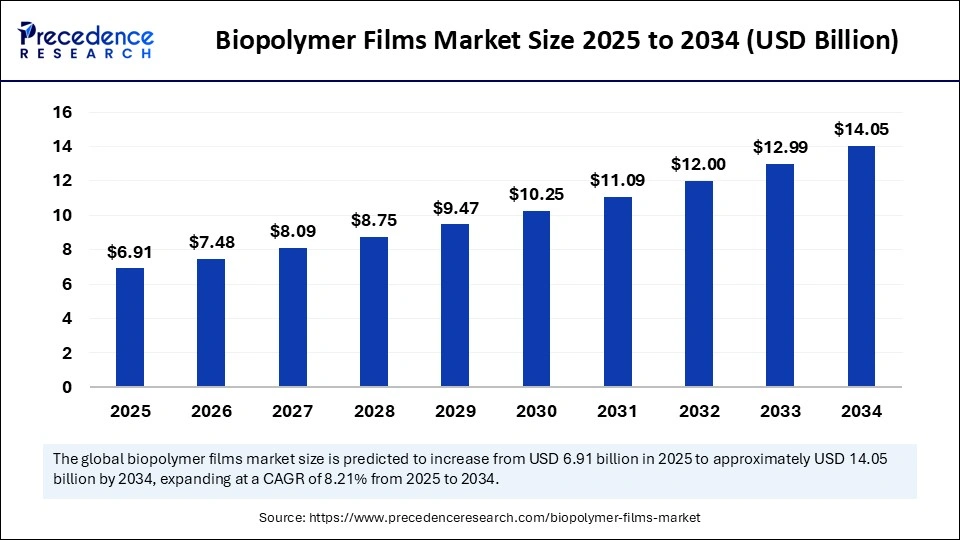
The global biopolymer films market is on track to grow from USD 6.91 billion in 2025 to USD 14.05 billion by 2034, expanding at a CAGR of 8.21%, according to a new report by Precedence Research. Driven by tightening environmental regulations, consumer demand for sustainable packaging, and technological innovations such as AI-powered material optimization, the market is witnessing a paradigm shift from petroleum-based plastics to eco-friendly biopolymer alternatives.

Quick Insights
-
Market Size (2024): USD 6.38 billion
-
Forecast (2034): USD 14.05 billion
-
CAGR (2025–2034): 8.21%
-
Top Region (2024): Asia Pacific (33% share)
-
Fastest Growing Region: North America
-
Leading Material (2024): Polylactic Acid (PLA) Films (30% share)
-
Fastest Growing Material: Polyhydroxyalkanoates (PHA) Films
-
Largest Application (2024): Packaging (45% share)
-
Top End-User Industry (2024): Food & Beverage (38% share)
-
Key Players: NatureWorks LLC, BASF SE, Novamont, Braskem, Mitsubishi Chemical, Toray Industries, Danimer Scientific.
Why Is the Biopolymer Films Market Growing So Rapidly?
The momentum behind biopolymer films is fueled by global anti-plastic legislation, brand-level sustainability commitments, and consumer preference for eco-friendly packaging. Regulations like California’s Extended Producer Responsibility (SB 54) and the EU’s Packaging Waste Directive are forcing industries to pivot away from conventional plastics. At the same time, retail giants and FMCG brands are adopting biopolymer-based flexible films to enhance shelf appeal while meeting sustainability goals.
“Biopolymer films are no longer niche — they are at the heart of global packaging transformation. From compostable tea bag wraps to AI-optimized edible films, the industry is embracing innovation at an unprecedented pace. We anticipate an accelerated uptake across packaging, healthcare, and agriculture over the next decade,” said Dr. Ananya Mehra, Principal Consultant at Precedence Research.
This Report is Readily Available for Immediate Delivery | Download the Sample Pages of this Report@ https://www.precedenceresearch.com/sample/6724
Regional Insights: Who Leads and Who’s Catching Up?
Asia Pacific: The Undisputed Leader
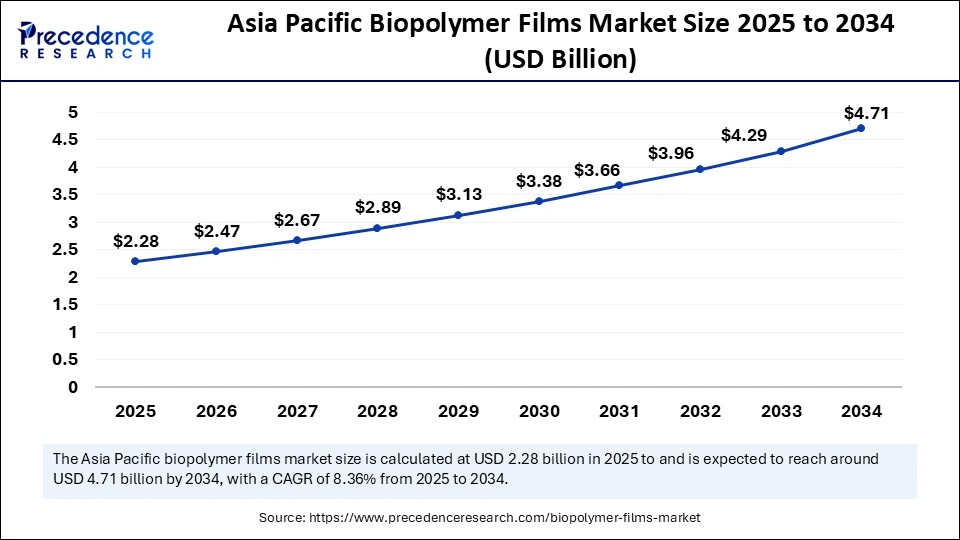
Asia Pacific dominated the market in 2024 with 33% share, valued at USD 2.28 billion in 2025 and projected to reach USD 4.71 billion by 2034 at a CAGR of 8.36%.
-
India mandates CPCB-certified compostable products, driving adoption across FMCG and agriculture.
-
Japan has set an ambitious target of 2 million tons of bioplastics by 2030, advancing multilayer and cellulose-based films.
-
China’s restrictions on single-use plastics are forcing large-scale transition toward biodegradable packaging.
North America: Fastest Growing Region
With California’s compostability mandates and corporate sustainability pledges, North America is forecasted to register the fastest CAGR through 2034.
-
In March 2025, the Oman Investment Authority invested in a U.S.-based biopolymers firm, highlighting cross-border sustainability investments.
-
Advanced PHA-based blends are reshaping packaging and healthcare solutions, strengthening North America’s growth trajectory.
Europe: Policy-Driven Transformation
Europe continues to lead in regulatory-led adoption. The EU Packaging Waste Regulation mandates compostable films in food applications like tea bags and fruit stickers by 2028. High R&D intensity, particularly in biodegradable mulch films for agriculture, positions Europe as a frontrunner in innovation.
Biopolymer Films Market Segments Highlights
By Material Type: Polylactic acid (PLA) films held the largest share of the market in 2024, accounting for 30% thanks to their cost-effectiveness, compostability, and wide availability from renewable sources such as corn starch and sugarcane. PLA is increasingly replacing petroleum-based plastics in packaging, agriculture, and disposable products. On the other hand, polyhydroxyalkanoates (PHA) films are emerging as the fastest-growing material type. With the unique ability to fully biodegrade even in marine environments, PHAs are gaining traction in specialty packaging, medical applications, and single-use items, supported by growing investments and regulatory incentives.
By Film Type:
Biodegradable films dominated the market in 2024 with a 40% share, largely propelled by rising global bans on single-use plastics and the growing preference for eco-friendly alternatives across consumer goods and industrial applications. These films are increasingly used in packaging and agriculture as brands shift to sustainable solutions. Meanwhile, edible films are the fastest-growing film type, particularly in food coatings, pharmaceuticals, and confectionery. Designed to be safe for consumption, edible films add value by extending shelf life and reducing waste, while opening new possibilities for ready-to-eat products and drug delivery systems.
By Technology: Extrusion led the technology segment with 35% of the market in 2024, as it remains the most established and scalable production process for biopolymer films. Its cost efficiency, ability to maintain uniform thickness, and adaptability for different polymer blends make extrusion the preferred choice for large-scale packaging applications. Solvent casting, however, is witnessing the fastest growth, especially in medical and pharmaceutical use cases. This technology allows for precise customization of film properties such as porosity and thickness, making it well-suited for applications like drug delivery films and biodegradable medical coatings.
By Application: Packaging stood as the largest application area in 2024, capturing 45% of the market. The food and beverage industry has been the strongest adopter, with bakery, dairy, fresh produce, and beverage packaging all transitioning to biopolymer films to meet consumer demand for sustainability and comply with regulatory mandates on plastic waste reduction. The medical and healthcare sector is poised to grow the fastest, as biopolymer films find expanding roles in drug delivery systems, wound dressings, and biodegradable medical devices, thanks to their biocompatibility and degradability.
By End-User Industry: Food and beverage was the leading end-user segment in 2024, holding 38% of the market share. Biopolymer films are widely used in this sector for packaging, labels, and coatings, offering both compostability and the ability to preserve product freshness, making them an ideal fit for eco-conscious consumers and sustainability-driven brands. In contrast, the pharmaceuticals and healthcare sector is expected to be the fastest-growing end-user. Here, biopolymer films are increasingly utilized in sensitive applications such as controlled drug release, medical packaging, and functional wound care, supported by growing investments in bio-based healthcare materials.
By Distribution Channel: Direct sales dominated the distribution landscape in 2024 with a 42% share, as manufacturers typically prefer supplying biopolymer films directly to large-scale industries like food packaging and agriculture. Direct channels offer better customization, bulk pricing, and stronger client relationships, making them a preferred route for major buyers. Online retail, however, is expanding at the fastest pace. The rise of e-commerce platforms has opened access for SMEs and startups to purchase sustainable films, while also enabling eco-conscious consumers to find and adopt greener packaging alternatives at competitive prices.
How Is Artificial Intelligence Transforming Biopolymer Films?
Artificial Intelligence (AI) is emerging as a disruptive force:
-
University of Maryland’s AI platform (August 2025) aims to accelerate biodegradable polymer film development.
-
AI is enabling multi-objective optimization — films with longer shelf life, reduced waste, and customizable barrier properties.
-
This convergence of sustainability + digital innovation is bridging the gap between lab research and industrial-scale adoption.
Opportunities: Can Biopolymer Films Reinvent Agriculture?
One of the most promising frontiers is biodegradable agricultural mulch films. These films:
-
Improve soil health, temperature, and moisture retention.
-
Naturally decompose, eliminating costly disposal for farmers.
-
Support governments’ sustainable farming goals.
Field trials across Europe in 2024 demonstrated strong viability, signaling a breakthrough opportunity for biopolymer films in agriculture.
Challenges: What’s Holding Back Biopolymer Films?
Despite strong demand, cost pressures remain a significant restraint:
-
Biopolymer films are 3–4 times costlier than conventional plastic films.
-
Supply chain disruptions in corn, sugarcane, and cellulose feedstocks create raw material price volatility.
-
Limited economies of scale hinder mass-market affordability.
Unless addressed, these challenges could slow down adoption in price-sensitive industries like food packaging.
Recent Breakthroughs: Industry Innovations
-
NatureWorks (March 2025): Launched Ingeo™ BOPLA films, delivering higher mechanical strength and faster biodegradability.
-
UKHI (June 2025): Released EcoGran, a revolutionary Indian biopolymer supporting circular economy principles.
-
Braskem & Novamont: Scaling up PHA and starch-based films for flexible packaging.
-
Danimer Scientific & BASF: Advancing blends for higher performance compostable films.
Case Study: Compostable Films in Retail Packaging
A leading global beverage brand introduced PLA and PHA-based multilayer films across its bottled water labels in 2024. The initiative:
-
Reduced annual plastic consumption by 1,200 tons.
-
Achieved ISO 17088 compostability certification.
-
Boosted brand reputation among eco-conscious millennials.
This case exemplifies how corporate sustainability targets and regulatory compliance are converging to drive market growth.