

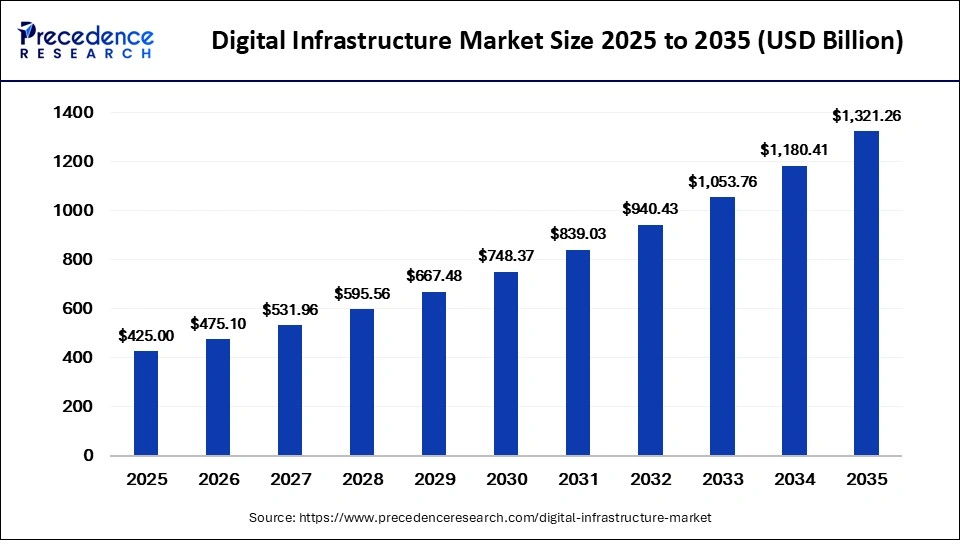
The global digital infrastructure market is entering a transformative growth phase as enterprises, governments, and technology providers invest heavily in next-generation digital ecosystems. The market size was valued at USD 425 billion in 2025 and is projected to increase from USD 475.1 billion in 2026 to approximately USD 1,321.26 billion by 2035, expanding at a CAGR of 11.8% during the forecast period. The surge in artificial intelligence (AI) workloads, cloud adoption, hyperscale data center expansion, and 5G deployment is creating unprecedented demand for advanced digital infrastructure solutions.

As organizations continue digital transformation initiatives, digital infrastructure has evolved from an operational necessity into a strategic business asset. Modern enterprises increasingly require scalable computing resources, high-performance networks, cloud-native platforms, and low-latency connectivity to support AI, machine learning, IoT, and real-time analytics applications.
Read Also: Ethoxyquin Market
Quick Insights: Why Is the Digital Infrastructure Market Becoming So Critical?
- The global digital infrastructure market was valued at USD 425 billion in 2025 and is expected to reach USD 1,321.26 billion by 2035.
- North America accounted for the largest market share of 36% in 2025 due to strong investments in AI infrastructure and hyperscale data centers.
- Asia Pacific is projected to expand at the fastest CAGR of 14.5% through 2035, supported by cloud adoption, telecom modernization, and government-led digital initiatives.
- Data center infrastructure represented the leading infrastructure segment with a 31% revenue share in 2025.
- Hardware remained the largest component segment, contributing 58% of total market revenue.
- Cloud-based deployment dominated the market with a 44% share as organizations increasingly migrate workloads to scalable cloud environments.
- Artificial intelligence infrastructure is anticipated to witness the fastest growth, registering a CAGR of 18.7% through 2035.
How Is Artificial Intelligence Reshaping the Digital Infrastructure Market?
Artificial intelligence has emerged as both a major consumer and enabler of digital infrastructure. The rapid adoption of generative AI, large language models (LLMs), machine learning platforms, and advanced analytics solutions is significantly increasing demand for high-performance computing resources. Organizations are deploying specialized AI accelerators, GPU clusters, advanced storage systems, and high-density server architectures to support increasingly complex AI workloads.
At the same time, AI is improving infrastructure management itself. Data center operators are increasingly utilizing predictive maintenance, intelligent workload balancing, automated energy optimization, and AI-driven cooling systems to improve efficiency while reducing operational costs. These capabilities are becoming critical as AI workloads consume larger amounts of computing power and electricity.
What Is Fueling Growth in the Digital Infrastructure Market?
Rapid Cloud Adoption Across Industries
Cloud computing remains one of the most powerful growth drivers. Organizations are increasingly adopting public, private, and hybrid cloud environments to improve scalability, flexibility, and operational efficiency. The expansion of cloud-native applications and distributed computing architectures continues to accelerate infrastructure investments.
Explosive Growth of AI Workloads
Training and deploying AI models requires enormous computational resources. This demand is driving investments in advanced data centers, GPU infrastructure, networking systems, and next-generation cooling technologies.
Expansion of 5G Networks
Telecommunications providers worldwide are investing heavily in 5G infrastructure to support low-latency applications, smart cities, autonomous vehicles, and industrial IoT ecosystems. The widespread deployment of 5G is creating substantial opportunities for digital infrastructure providers.
Growth of Edge Computing
The increasing need for real-time processing is pushing enterprises toward edge infrastructure. Processing data closer to its source reduces latency and improves performance for mission-critical applications.
What Trends Are Defining the Future of Digital Infrastructure?
AI-Optimized Data Centers Are Becoming Mainstream
Traditional facilities are being redesigned to accommodate GPU-intensive workloads and high-density computing environments.
Liquid Cooling Technologies Are Gaining Adoption
As AI servers generate greater heat loads, direct-to-chip liquid cooling systems are becoming essential for operational efficiency.
Data Sovereignty Is Driving Localized Infrastructure
Governments are implementing stricter data privacy regulations, encouraging organizations to establish regional data centers and sovereign cloud environments.
Edge Infrastructure Investments Continue Rising
Low-latency applications in healthcare, manufacturing, transportation, and telecommunications are accelerating edge computing deployments.
Why Does North America Continue to Lead the Market?
North America captured 36% of global revenue in 2025 due to strong adoption of AI technologies, extensive cloud computing infrastructure, and the presence of leading hyperscale data center operators. The United States remains the primary growth engine, supported by significant investments in AI computing, cloud services, and advanced networking technologies.
The region’s mature technology ecosystem, robust venture capital environment, and continuous innovation across AI and cloud computing further reinforce its leadership position.
Why Is Asia Pacific Emerging as the Fastest-Growing Region?
Asia Pacific accounted for 30% of global revenue in 2025 and is expected to record the fastest CAGR of 14.5% through 2035. The region benefits from large-scale investments in telecommunications, cloud computing, AI infrastructure, and smart city development. Countries such as China, India, Japan, South Korea, and Southeast Asian economies continue to prioritize digital transformation initiatives.
Rapid internet penetration, growing smartphone adoption, and increasing use of digital services are further strengthening regional demand.
Which Companies Are Driving Innovation in Digital Infrastructure?
Major technology providers, cloud operators, networking companies, and infrastructure developers are actively investing in AI-ready infrastructure and next-generation connectivity solutions.
Key Companies Mentioned Across the Digital Infrastructure Ecosystem
- Amazon Web Services
- Microsoft
- Google Cloud
- NVIDIA
- Cisco Systems
- Huawei Technologies
- Ericsson
- Nokia
- Equinix
- Digital Realty
What Challenges Could Limit Market Expansion?
Rising Energy Consumption
AI workloads require significant computing power, creating increased electricity demand and operational costs for data center operators.
Data Sovereignty Regulations
Strict regulations governing data storage and processing increase compliance costs and complicate global infrastructure deployments.
Capital-Intensive Investments
Building hyperscale data centers, edge facilities, and next-generation telecom networks requires substantial upfront capital expenditures.
Skilled Workforce Shortages
The growing complexity of AI infrastructure, cloud environments, and cybersecurity systems is increasing demand for specialized talent.
Case Study: AI Infrastructure Expansion in Enterprise Data Centers
A multinational financial services company modernized its legacy infrastructure by adopting a hybrid cloud architecture integrated with AI-powered analytics platforms. The project included high-performance computing clusters, software-defined networking, and predictive maintenance solutions.
The transformation reduced latency, improved workload scalability, enhanced cybersecurity resilience, and accelerated AI deployment across customer-facing applications. The initiative demonstrates how modern digital infrastructure can directly improve operational performance and business outcomes.
Conclusion
The digital infrastructure market is poised for remarkable expansion over the next decade as AI, cloud computing, edge computing, and 5G technologies reshape global business operations. With market value expected to exceed USD 1.32 trillion by 2035, digital infrastructure will remain a critical enabler of innovation, competitiveness, and economic growth. Organizations that invest early in scalable, sustainable, and AI-ready infrastructure will be best positioned to capitalize on future opportunities.
𝐃𝐨𝐰𝐧𝐥𝐨𝐚𝐝 𝐚 𝐅𝐫𝐞𝐞 𝐒𝐚𝐦𝐩𝐥𝐞: https://www.precedenceresearch.com/sample/8466
For inquiries regarding discounts, bulk purchases, or customization requests, please contact us at sales@precedenceresearch.com