
Enzyme Inhibitor Market Set to Reach USD 45.72 Billion by 2034, Amid AI-Driven Drug Discovery Surge
What Is Driving the Growth of the Enzyme Inhibitor Market in the Coming Decade?
The enzyme inhibitor market is entering a new era of growth, expanding from a baseline value of USD 27.02 billion in 2024 to a projected USD 28.48 billion in 2025, and ultimately reaching USD 45.72 billion by 2034, fueled by a CAGR of 5.4%. This upward trajectory is being powered by multiple factors. Firstly, the rising prevalence of chronic conditions such as cancer, diabetes, Alzheimer’s disease, and cardiovascular issues is pushing pharmaceutical companies to develop targeted enzyme therapies. Enzyme inhibitors, by design, block specific enzymatic activity associated with these diseases, making them a cornerstone in modern pharmacology.
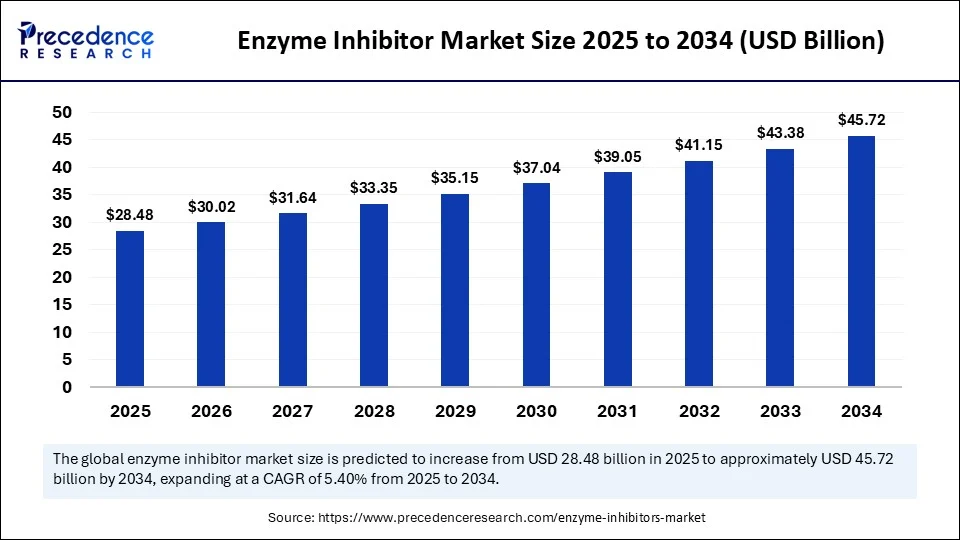
Moreover, the biopharmaceutical sector is witnessing massive expansion, especially in emerging markets where R&D capabilities are growing rapidly. This has led to increased investment in enzyme-targeted therapies and innovation in both synthetic and biologically derived inhibitors. The shift toward personalized and precision medicine is also catalyzing growth, as healthcare providers seek therapies that modulate enzymatic pathways specific to an individual’s genotype. With healthcare systems placing greater emphasis on outcome-based therapies, enzyme inhibitors are well-positioned as scalable, efficacious, and clinically proven options.
Enzyme Inhibitor Market Key Points
- In terms of revenue, the global enzyme inhibitor market was valued at USD 27.02 billion in 2024.
- It is projected to reach USD 45.72 billion by 2034.
- The market is expected to grow at a CAGR of 5.40% from 2025 to 2034.
- North America dominated the global enzyme inhibitor market with the largest share of 39% in 2024.
- Asia Pacific is anticipated to grow at a significant CAGR from 2025 to 2034.
- By type, the kinase inhibitors segment contributed the biggest market share of 27% in 2024.
- By type, the protease inhibitors segment is expanding at a significant CAGR during the forecast period.
- By source, the synthetic enzyme inhibitors segment led the market share of 70% in 2024.
- By source, the natural enzyme inhibitors segment is expected to grow at a significant CAGR over the projected period.
- By therapeutic area, the oncology segment held the major market share of 33% in 2024.
- By therapeutic area, the neurological disorders segment is projected to grow at a CAGR between 2025 and 2034.
- By mechanism of action, the competitive inhibitors segment held the highest market share of 40% in 2024.
- By mechanism of action, the allosteric inhibitor segment is expanding at a significant CAGR from 2025 to 2034.
- By end use, the pharmaceutical and biotech companies segment captured the largest market share of 58% in 2024.
- By end use, the Contract Research Organizations (CROs) segment is anticipated to grow at a significant CAGR from 2025 to 2034.
- By route of administration, the oral segment held the major market share of 61% in 2024.
- By route of administration, the injectable segment is expected to grow at a significant CAGR over the projected period.
How Is Artificial Intelligence Transforming Drug Discovery for Enzyme Inhibitors?
Artificial intelligence is becoming a game-changer in drug discovery, and its impact on enzyme inhibitor development is particularly profound. AI tools are accelerating the identification of lead compounds by using machine learning to predict which molecules are most likely to bind effectively to enzyme targets. Through virtual screening and AI-driven inhibitor design, researchers can identify hits and optimize leads with unprecedented speed and precision.
In addition, AI is being deployed to predict pharmacokinetics and potential toxicity, reducing the reliance on time-consuming in vitro and in vivo models. This results in faster preclinical workflows, better safety profiling, and ultimately lower R&D costs. Notably, AI is now used to map out enzyme-substrate interactions in disease-specific metabolic pathways, allowing scientists to uncover novel binding sites and design selective enzyme inhibitors. The combination of AI and computational biology is ushering in a new age of smart drug development that minimizes risk while maximizing therapeutic efficiency.
Which Regions Are Leading the Global Enzyme Inhibitor Market?
North America remains the dominant force in the enzyme inhibitor market, holding 39% of global share in 2024. The United States alone accounted for USD 7.38 billion in 2024, and this figure is expected to climb to USD 12.73 billion by 2034. This is largely due to its strong biopharmaceutical infrastructure, robust regulatory support, and early adoption of AI-powered drug discovery platforms.
However, the fastest-growing region is Asia Pacific, with countries like China and India at the forefront. In China, government-led biotech initiatives and academic research partnerships are fostering innovation in enzyme therapies, while India is capitalizing on its talent pool and cost-effective manufacturing capabilities. The introduction of the Innovation Bill in India is also expected to stimulate academia-industry collaborations, especially in enzyme-related research.
Europe continues to remain a significant market, with a focus on antimicrobial resistance (AMR) and novel enzyme applications in both pharmaceutical and food sectors. Meanwhile, Latin America and the Middle East & Africa are gradually catching up, thanks to increasing awareness of enzyme-targeted chronic disease treatments and the growing presence of global CROs operating in these regions.
Why Are Kinase and Protease Inhibitors Dominating Drug Development Pipelines?
Among various enzyme inhibitor types, kinase and protease inhibitors stand out due to their wide-ranging applications in oncology, virology, and autoimmune disorders. Kinase inhibitors currently hold 27% of the market share, primarily because they are integral to cancer treatment. These molecules interfere with ATP-binding sites of protein kinases, effectively halting cell proliferation and metastasis. Blockbuster kinase inhibitors such as imatinib and palbociclib have demonstrated the therapeutic potential of this class and paved the way for next-gen compounds.
Protease inhibitors, on the other hand, are the fastest-growing segment due to their critical role in managing infectious diseases such as HIV and COVID-19, as well as their emerging application in oncology. Proteases are involved in the activation of viral particles and tumor progression, making them highly attractive targets. The demand for dual-function protease inhibitors is also increasing, particularly those that combine antiviral and anti-inflammatory effects in one formulation.
Markket Scope
| Report Coverage | Details |
| Market Size by 2034 | USD 45 .72 Billion |
| Market Size in 2025 | USD 45.72 Billion |
| Market Size in 2024 | USD 27.02 Billion |
| Market Growth Rate from 2025 to 2034 | CAGR of 5.40% |
| Dominating Region | North America |
| Fastest Growing Region | Asia Pacific |
| Base Year | 2024 |
| Forecast Period | 2025 to 2034 |
| Segments Covered | Type of Inhibitor, Source, Therapeutic Area, Mechanism of Action,End Use, Route of Administration and Region |
| Regions Covered | North America, Europe, Asia-Pacific, Latin America, and Middle East & Africa |
Are Synthetic or Natural Enzyme Inhibitors Leading the Market?
When it comes to the source of enzyme inhibitors, synthetic variants are currently leading the pack, accounting for around 70% of the total market. This dominance can be attributed to the scalability, consistent purity, and lower production costs of chemically synthesized inhibitors. Additionally, synthetic molecules can be engineered for enhanced bioavailability, target specificity, and controlled release mechanisms—factors that are highly valued in modern pharmacotherapy.
That said, natural enzyme inhibitors are gaining renewed interest, particularly in academic research and early-stage drug discovery. Derived from plants, microbes, and marine organisms, natural inhibitors often possess higher safety profiles and specificity. In Asia, especially in China, traditional medicine is influencing research in natural enzyme blockers derived from fermented foods such as Douchi, showcasing the blend of traditional knowledge with modern biotech.
Which Therapeutic Areas Are Showing the Highest Demand?
Oncology remains the dominant therapeutic area, accounting for approximately 33% of enzyme inhibitor demand. In cancer treatment, enzyme inhibitors play a pivotal role by blocking pathways that allow tumor growth, angiogenesis, and immune evasion. Their application in combination therapies is also increasing, especially in advanced-stage and metastatic cancers.
The fastest-growing therapeutic application, however, is in neurological disorders. Diseases such as Alzheimer’s and Parkinson’s are being addressed using enzyme-targeting mechanisms that regulate neurotransmitter breakdown and neuroinflammation. For instance, acetylcholinesterase inhibitors improve cognitive function in Alzheimer’s patients, while monoamine oxidase (MAO-B) inhibitors are used for managing Parkinson’s disease symptoms. The aging global population is expected to push demand even further in the neurology segment.
How Do Competitive and Allosteric Inhibitors Differ – and Why Does It Matter?
Competitive inhibitors dominate the market with a 40% share, mainly due to their predictable mechanism of action. These inhibitors bind directly to the enzyme’s active site, competing with the natural substrate. Their pharmacokinetics are well understood, making them easier to dose and regulate. They are particularly popular in therapies requiring enzyme modulation over extended periods, such as in diabetes or hypertension.
However, allosteric inhibitors are gaining ground, especially in newer R&D pipelines. These compounds bind to sites other than the active site, inducing conformational changes that reduce enzyme activity. This method offers higher precision, fewer side effects, and less potential for resistance. Allosteric inhibition is increasingly being explored in neurological and autoimmune diseases, where fine-tuned control of enzyme function is critical.
Who Are the Key Drivers of Innovation – Pharma Giants or CROs?
Pharmaceutical and biotechnology companies continue to lead innovation, holding 58% of the market share. Industry leaders like Pfizer, Merck & Co., AstraZeneca, Roche, and Gilead Sciences are heavily invested in developing novel enzyme inhibitors, particularly in the fields of oncology and metabolic disorders. Their strong financial backing allows for high-risk, high-reward investments in AI-based discovery and personalized enzyme therapies.
Contract Research Organizations (CROs) are the fastest-growing end-users. With more companies outsourcing clinical trials and preclinical studies, CROs have emerged as agile innovation hubs. They bring deep expertise in enzyme assays, regulatory strategy, and high-throughput screening, making them essential partners in drug development. Their cost-effective operations are particularly attractive for small-to-mid-sized biotech firms.
Read Also: Endometriosis Treatment Market Size to Surpass USD 5.74 Billion by 2034
Why Are Oral Enzyme Inhibitors the Preferred Formulation?
Oral enzyme inhibitors dominate the market with a 61% share, primarily because they offer ease of use, better patient compliance, and are suitable for long-term therapies. Oral administration is particularly common in chronic disease treatments such as diabetes (DPP-4 inhibitors) and cardiovascular disorders (ACE inhibitors). These formulations are often available in extended-release forms, ensuring sustained therapeutic effect and minimal dosing frequency.
Meanwhile, injectable formulations are gaining popularity in acute care settings where rapid onset of action is required. They are especially relevant in emergency medicine, cancer treatments, and enzyme-targeted biologics. The recent rise in biologic drugs, which are often administered via injection, is expected to further boost this segment in the coming years.
What Are Some Noteworthy Regional Innovations?
Innovation in enzyme inhibitors isn’t confined to the West. In China, researchers are developing novel ACE inhibitors from traditional food sources like Douchi, while biotech investment in enzyme-targeted drugs is on the rise. India and Sri Lanka are fostering innovation through government initiatives such as the Innovation Bill, promoting academia-industry partnerships in pharmaceutical research.
Europe is focusing heavily on antimicrobial resistance (AMR) and enzyme inhibitors that combat resistant pathogens. Enzyme therapies are also being adopted in food technology, cosmetics, and nutraceuticals, particularly in Scandinavian countries. These regional shifts signal a decentralization of innovation, with multiple geographies shaping the future of enzyme therapeutics.
What Are the Major Challenges Facing the Market?
Despite its promise, the enzyme inhibitor market is not without challenges. A significant concern is the expiration of key patents, which paves the way for generics and biosimilars that reduce profit margins. Additionally, enzyme inhibitors can sometimes produce side effects such as gastrointestinal distress, dizziness, or tolerance, requiring additional research into selective and safer variants.
Regulatory approval remains a complex and time-consuming process, especially for novel mechanisms of action or multi-target inhibitors. Market saturation in certain segments, like statins and ACE inhibitors, may also lead to stiff competition and price wars. Overcoming these hurdles will require smarter drug design, better companion diagnostics, and stronger post-market surveillance.
Is Personalized Medicine the Future of Enzyme Inhibition?
Personalized medicine is no longer a buzzword—it is the future of enzyme inhibitor therapies. With advancements in genotyping and biomarker identification, it is now possible to match specific enzyme targets with individual patient profiles. This allows for selective inhibition, minimizing off-target effects and maximizing therapeutic benefit.
Pharmaceutical companies are integrating AI and real-world data analytics to design inhibitors that are tailored to unique metabolic or enzymatic signatures. In the near future, expect to see more companion diagnostic kits paired with enzyme inhibitor prescriptions, especially in cancer and neurology.