
IV Bags Market Surges Toward $7.2 Billion by 2034
IV Bags – Powering Modern Healthcare Growth
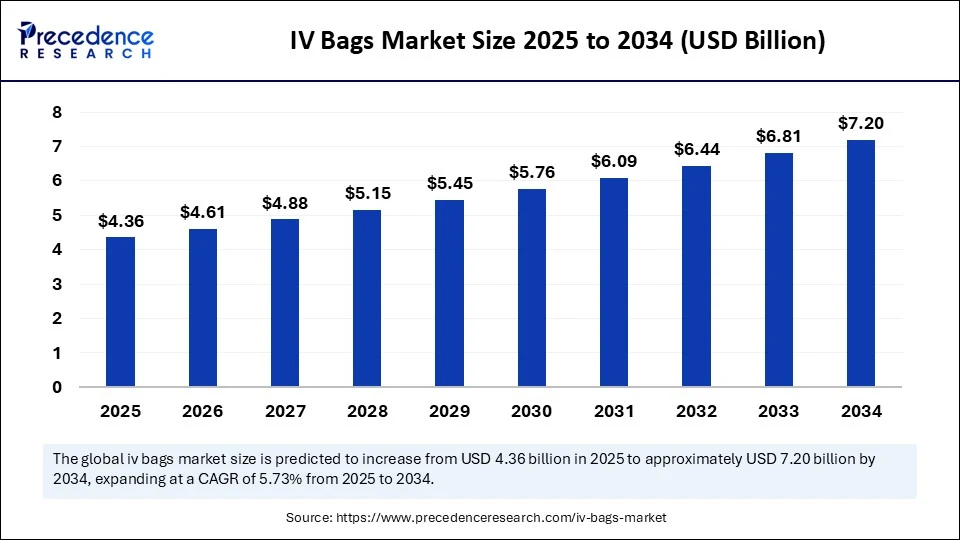
The global intravenous (IV) bags market is undergoing a transformational wave, projected to achieve a remarkable value of USD 7.2 billion by 2034. Industry analysts highlight a robust CAGR of 5.73% (2025–2034), driven by a rise in chronic diseases, expansion of outpatient and home healthcare, stringent safety standards, and the burgeoning application of artificial intelligence (AI) across manufacturing and logistics. With North America remaining dominant and Asia-Pacific fast catching up, the industry is witnessing massive investment in green IV solutions and advanced, patient-centric drug delivery formats.
Quick Insights
Market Size (2025): USD 4.36 Billion
Forecasted Size (2034): USD 7.20 Billion
CAGR (2025–2034): 5.73%
Top Region by Revenue: North America
Fastest Growing Region: Asia-Pacific
Leading Material: Polyvinyl Chloride (PVC), but non-PVC is fastest growing
Dominant Product Category: Single-Chamber IV Bags
Largest End-User: Public Hospitals
Top Distribution Channel: Government and Institutional Tenders
Key Players (Manufacturing): Baxter, ICU Medical, Fresenius Kabi, Pfizer
Key Suppliers (Raw Materials): SABIC, BASF, LG Chem, Mitsui Chemicals
This Report is Readily Available for Immediate Delivery | Download the Sample Pages of this Report@ https://www.precedenceresearch.com/sample/6715
What Opportunities and Trends Are Shaping the IV Bags Market in 2025 and Beyond?
How Eco-Innovation, AI, and Healthcare Access Fuel Demand
Green Materials Surge: The global market is actively shifting from traditional PVC towards non-PVC and DEHP-free alternatives. Regional regulations and hospital sustainability initiatives are accelerating this transition. Manufacturers are leveraging advanced polymers like polypropylene and polyethylene for eco-friendly, recyclable, and biodegradable products, supported by FDA policy momentum in the U.S.
Smart IV Bags & AI: Industry leaders are embedding AI-powered sensors in IV bags for real-time monitoring of fluid levels and flow rates. Automated manufacturing, predictive analytics, and digitized supply chains further increase reliability and reduce waste.
Outpatient and Home Care Boom: Rapid expansion of outpatient care and home-based treatments — especially for chronic illness management and aging populations — is driving demand for portable, user-friendly IV bags and associated home delivery services.
Digitized Procurement: B2B medical platforms like MedikaBazaar and Alibaba Health are streamlining supply chains, enabling even small clinics to access bulk, quality-assured IV bags at competitive prices.
Expert View
“As the IV bags market enters a new growth phase, sustainability and digital transformation are at the forefront of innovation. From non-PVC formulations to AI-assisted production and direct-to-hospital online procurement, the sector is optimizing patient safety and operational efficiency while paving the way for a greener healthcare ecosystem.”
— Dr. Sahana Iyengar, Principal Consultant, Precedence Research
Market Scope
| Report Coverage | Details |
| Market Size by 2034 | USD 7.20 Billion |
| Market Size in 2025 | USD 4.36 Billion |
| Market Size in 2024 | USD 4.13 Billion |
| Market Growth Rate from 2025 to 2034 | CAGR of 5.73% |
| Dominating Region | North America |
| Fastest Growing Region | Asia Pacific |
| Base Year | 2024 |
| Forecast Period | 2025 to 2034 |
| Segments Covered | Material Type, Product Type, Usage Type, End User, Distribution Channel, and Region |
| Regions Covered | North America, Europe, Asia-Pacific, Latin America, and Middle East & Africa |
Regional and Segment Analysis
North America: Market Leadership Rooted in Innovation
North America holds the lion’s share of global IV bag revenues, underpinned by advanced healthcare infrastructure, strict regulatory standards, and rapid adoption of DEHP-free/non-PVC solutions. The U.S., alone worth USD 0.98 billion in 2024, could touch USD 1.75 billion by 2034, clocking a higher-than-average CAGR. Here, post-pandemic shifts, hospital sustainability campaigns, and FDA vigilance prioritize both infection control and ecological impact, fueling investments from market heavyweights like Baxter, ICU Medical, and Fresenius Kabi.
Asia Pacific: Fastest Growth Trajectory
Asia-Pacific is projected to see the fastest CAGR for empty IV bags. Key drivers include:
Expanding healthcare infrastructure (especially in China, India, and Japan)
Accelerated public health investments and domestic manufacturing push
Growing adoption of affordable, non-PVC IV solutions, especially in urban hospitals and clinics
This regional boom is bolstered by strong government initiatives and a vast population base increasingly accessing modern hospital and home care.
Product and Material Insights
Material: PVC remains dominant (reliable, cost-effective) but non-PVC is surging fastest due to performance, safety, and regulatory alignment.
Product: Single-chamber bags dominate for hydration, electrolyte replacement, and medication delivery, credited for minimal contamination risk, streamlined design, and regulatory compliance.
usage: Single use IV bags are standard due to infection control and cost efficiency. However, the reusable segment is gaining ground thanks to medical waste awareness and next-gen material innovations.
End-User and Distribution
End-User: Public hospitals are top consumers. Home healthcare is the fastest-rising segment, fitting the trend towards chronic care and treatment convenience.
Distribution: Government/institutional tenders dominate via bulk purchasing for reliable supply. B2B online platforms represent the most dynamic channel, increasing transparency and efficiency.
Latest Breakthroughs: Company Innovations
AI Manufacturing & Predictive QC: Industry leaders like Baxter and ICU Medical harness AI for automated quality checks, detecting microscopic defects that escape manual inspection—a breakthrough for sterility and patient safety.
Smart Sensor Integration: Ongoing R&D is embedding sensors in IV bags for real-time tracking, advancing patient monitoring, particularly for home care and complex therapies.
Sustainable Material Sourcing: Major raw material suppliers (SABIC, BASF, LG Chem) and manufacturers (Mitsui Chemicals) are rapidly ramping up eco-friendly, recyclable alternatives to conventional PVC and DEHP.
Multi-Chamber Customization: Innovations in multi-chamber bags for parenteral nutrition and oncology allow on-demand mixing of complex therapies, supporting the surge in personalized medicine applications.
Challenges and Industry Pressures
Material Pricing and Supply Volatility: Fluctuating costs of polymers and clinical-grade plastics affect manufacturing economics, especially in emerging markets.
Waste and Environmental Impact: Traditional PVC-based bags generate considerable medical waste, drawing increased scrutiny and compliance costs.
Stringent Regulatory Barriers: Diverse, evolving medical device regulations increase entry barriers and prolong development cycles, most pronounced for novel and sustainable material lines.
Quality Assurance and Counterfeit Risks: Ensuring global sterility and mitigating the risks of sub-standard or counterfeit products requires vigilant compliance and advanced tracking.
Case Study: Smart IV Bag Deployment in U.S. Outpatient Clinics
In 2025, a consortium involving Baxter and several major U.S. hospital groups piloted smart IV bags equipped with AI-driven sensors. Result: a 24% reduction in fluid delivery errors and a significant drop in hospital-acquired infections over nine months. Clinics reported notably improved patient confidence and safety, with the technology swiftly scaling into home healthcare deployments to support chronic care in elderly patients.
Thanks for reading you can also get individual chapter-wise sections or region-wise report versions such as North America, Europe, or Asia Pacific.
Immediate Delivery Available | Buy This Premium Research Report@ https://www.precedenceresearch.com/checkout/6715
You can place an order or ask any questions, please feel free to contact at sales@precedenceresearch.com | +1 804 441 9344
Precedence Research offers exclusive subscription services designed to provide in-depth data and analytics insights. With a subscription, you gain access to a comprehensive suite of statistical resources, market intelligence, and research tools tailored to your business needs. Whether you’re looking for industry trends, competitive analysis, or future market projections, our subscription plans ensure you stay ahead with reliable, up-to-date information.
Browse Our Subscription Plans@ https://www.precedenceresearch.com/get-a-subscription