
Magnetoresistive Random Access Memory Market Size to Attain USD 16.46 Billion by 2035
The global magnetoresistive random access memory (MRAM) market size is calculated at USD 1.52 billion in 2025 and is predicted to increase from USD 2.19 billion in 2026 to approximately USD 16.46 billion by 2035, expanding at a CAGR of 25.1% from 2026 to 2035.
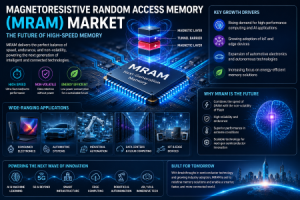
Understanding MRAM Technology
MRAM is a non-volatile memory technology that stores data using magnetic states instead of electric charges. Unlike conventional memory systems that lose stored information when power is removed, MRAM retains data even during power outages.
At the core of MRAM technology is the Magnetic Tunnel Junction (MTJ), which consists of two magnetic layers separated by an insulating barrier. Information is stored based on the orientation of these magnetic layers, enabling fast and reliable data storage while reducing energy consumption.
MRAM offers several benefits over traditional memory technologies:
- Non-volatile data retention
- High-speed read and write operations
- Low power consumption
- Excellent endurance
- Instant-on functionality
- Superior reliability in harsh environments
These characteristics make MRAM suitable for applications ranging from consumer electronics to enterprise storage systems.
Get Sample: https://www.precedenceresearch.com/sample/3991
Magnetoresistive Random Access Memory Market Overview
The Magnetoresistive Random Access Memory (MRAM) market is gaining significant momentum as industries seek memory solutions that combine speed, reliability, and energy efficiency. MRAM is a non-volatile memory technology that stores data using magnetic states rather than electrical charges, allowing information to be retained even when power is turned off. This unique capability makes MRAM an attractive alternative to conventional memory technologies such as DRAM, SRAM, and NAND flash.
The growing need for high-performance computing, artificial intelligence, edge computing, connected devices, and advanced automotive systems is accelerating the adoption of MRAM worldwide. As semiconductor manufacturers continue to improve memory density and reduce production costs, MRAM is increasingly being recognized as a critical component of future computing architectures.
Magnetoresistive Random Access Memory Market Growth
The MRAM market is witnessing robust growth due to the increasing demand for advanced memory technologies capable of supporting data-intensive applications. The rise of artificial intelligence, machine learning, cloud computing, and industrial automation has created a need for memory solutions that offer faster processing speeds, lower power consumption, and greater reliability. MRAM addresses these requirements by delivering high-speed performance while maintaining non-volatile data storage capabilities.
Another key factor driving market growth is the rapid expansion of the Internet of Things (IoT) ecosystem and smart connected devices. Manufacturers are integrating MRAM into consumer electronics, automotive systems, and industrial equipment to improve operational efficiency and enhance device performance. Continuous technological advancements and increasing investments in semiconductor research are expected to further accelerate market expansion in the coming years.
Magnetoresistive Random Access Memory Market Trends
- Growing Integration of AI and Edge Computing: MRAM is increasingly being adopted in AI processors and edge computing devices due to its ability to provide rapid data access and low power consumption. These characteristics help improve real-time processing and reduce latency in intelligent systems.
- Rising Demand for Embedded Memory Solutions: Semiconductor manufacturers are incorporating MRAM into system-on-chip (SoC) designs and microcontrollers. This trend is enabling more compact, energy-efficient, and high-performance electronic devices.
- Advancements in Spin-Transfer Torque MRAM (STT-MRAM): STT-MRAM technology continues to gain popularity because of its scalability, faster operation, and improved endurance. Ongoing innovations are making it suitable for a wider range of commercial applications.
- Increasing Adoption in Automotive Electronics: The shift toward electric and autonomous vehicles is driving demand for durable and high-speed memory solutions. MRAM’s ability to perform reliably under extreme temperatures makes it particularly valuable for automotive applications.
Advantages of MRAM Over Traditional Memory Technologies
MRAM provides several advantages compared to conventional memory technologies such as DRAM, SRAM, and NAND flash memory. One of its most significant benefits is non-volatility, which allows stored data to remain intact even when power is removed. MRAM also delivers faster read and write operations, enabling improved system responsiveness and reduced latency. Unlike flash memory, which has limited write cycles, MRAM offers exceptional endurance and can withstand frequent data updates without degradation. Additionally, its low power consumption makes it attractive for battery-powered devices and energy-conscious applications. These advantages position MRAM as a strong contender in the evolving memory technology landscape.
Technological Innovations Shaping the MRAM Industry
Continuous advancements in semiconductor engineering are accelerating the development of MRAM technology. Spin-Transfer Torque MRAM (STT-MRAM) has become the dominant MRAM architecture due to its scalability, high speed, and energy efficiency. Researchers are also exploring Spin-Orbit Torque MRAM (SOT-MRAM), which offers faster switching speeds and improved endurance for high-performance computing applications. Voltage-Controlled MRAM (VC-MRAM) is another emerging innovation aimed at reducing power consumption while increasing storage density. In addition, semiconductor manufacturers are integrating MRAM into advanced system-on-chip (SoC) designs, enabling more compact and efficient electronic devices. These technological breakthroughs are expected to expand MRAM’s commercial applications and accelerate market growth.
Read Also: Small Caliber Ammunition Market
Market Segmentation
By Technology Type
- Spin-Transfer Torque MRAM (STT-MRAM)
- Toggle MRAM
- Spin-Orbit Torque MRAM (SOT-MRAM)
- Voltage-Controlled MRAM (VC-MRAM)
By Offering and Integration
- Embedded MRAM (eMRAM)
- Standalone MRAM
- IP Cores and Design Services
By Storage Density
- Low-Density MRAM
- Medium-Density MRAM
- High-Density MRAM
By Application
- Data Logging and Parameter Storage
- Code Storage and Execution
- Working Memory and Cache
- Persistent AI Weights and Edge Inference
- Buffer Memory and Write Cache
By End-Use Industry
- Industrial Automation and Robotics
- Enterprise Storage and Data Centers
- Automotive Electronics
- Consumer Electronics
- Aerospace and Defense
- Healthcare
Challenges Facing the MRAM Market
Despite its strong growth potential, several challenges continue to impact market expansion.
- High Manufacturing Costs: MRAM fabrication requires advanced semiconductor manufacturing processes and specialized materials, resulting in higher production costs compared to conventional memory technologies.
- Competition from Established Memory Technologies: MRAM competes directly with mature technologies such as DRAM, SRAM, NAND Flash, ReRAM, and Phase Change Memory (PCM). These technologies benefit from well-established manufacturing ecosystems and large-scale production capabilities.
- Scalability and Density Limitations: Although significant progress has been achieved, increasing memory density while maintaining cost efficiency remains a key challenge for manufacturers.
Regional Analysis
Asia Pacific dominates the global MRAM market, accounting for more than 42% of market revenue. The region benefits from a strong semiconductor manufacturing ecosystem, extensive electronics production capabilities, and increasing investments in AI and cloud computing infrastructure. Countries such as China, Japan, South Korea, and Taiwan continue to drive regional growth.
North America remains a major center for semiconductor innovation and advanced computing research. The presence of leading technology companies, AI developers, and cloud service providers is accelerating MRAM adoption across multiple industries.
Europe is witnessing increasing MRAM deployment in automotive manufacturing, industrial automation, aerospace, and defense sectors. Government initiatives supporting semiconductor independence and technological innovation are contributing to market growth.
These regions are gradually expanding their digital infrastructure and technology investments, creating future opportunities for MRAM adoption in telecommunications, industrial systems, and smart city projects.
Competitive Landscape
The MRAM market is characterized by intense research and development activities aimed at improving performance, scalability, and manufacturing efficiency.
Major industry participants include:
- Samsung Electronics
- TSMC
- Everspin Technologies
- GlobalFoundries
- Intel Corporation
- NXP Semiconductors
- Infineon Technologies
These companies are focusing on technological innovation, strategic collaborations, and product development to strengthen their market positions and expand commercial applications.
Future Outlook
The future of the MRAM market appears exceptionally promising. As industries increasingly prioritize energy efficiency, real-time processing, and persistent memory solutions, MRAM is expected to play a critical role in next-generation computing architectures.
Emerging innovations such as SOT-MRAM, VC-MRAM, and advanced embedded MRAM technologies are expected to further enhance performance while reducing manufacturing costs. Growing adoption across AI infrastructure, autonomous vehicles, industrial automation, and cloud computing will continue to drive market expansion over the next decade.
𝐘𝐨𝐮 𝐜𝐚𝐧 𝐩𝐥𝐚𝐜𝐞 𝐚𝐧 𝐨𝐫𝐝𝐞𝐫 𝐨𝐫 𝐚𝐬𝐤 𝐚𝐧𝐲 𝐪𝐮𝐞𝐬𝐭𝐢𝐨𝐧𝐬, 𝐩𝐥𝐞𝐚𝐬𝐞 𝐟𝐞𝐞𝐥 𝐟𝐫𝐞𝐞 𝐭𝐨 𝐜𝐨𝐧𝐭𝐚𝐜𝐭 𝐮𝐬 𝐚𝐭 𝐬𝐚𝐥𝐞𝐬@𝐩𝐫𝐞𝐜𝐞𝐝𝐞𝐧𝐜𝐞𝐫𝐞𝐬𝐞𝐚𝐫𝐜𝐡.𝐜𝐨𝐦