

The global medical carts and workstations market size is calculated at USD 5.15 billion in 2025 and is predicted to increase from USD 6.13 billion in 2026 to approximately USD 28.11 billion by 2035, expanding at a CAGR of 18.50% from 2026 to 2035.

What Are Medical Carts and Workstations?
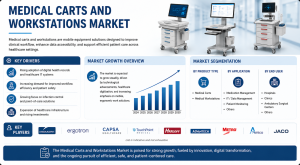
Medical carts and workstations are specialized mobile or stationary platforms designed to help healthcare professionals deliver efficient, organized, and patient-centered care. They serve as portable workstations that enable doctors, nurses, and other clinical staff to access patient information, transport medical equipment, administer medications, and complete documentation directly at the point of care. By bringing essential tools and technology to the patient’s bedside, these systems reduce unnecessary movement, improve workflow efficiency, and enhance the overall quality of healthcare services.
Modern medical carts have evolved far beyond simple storage units. They are now equipped with advanced technologies such as integrated computer systems, electronic health record (EHR) access, wireless connectivity, battery-powered computing units, barcode medication administration tools, secure storage drawers, diagnostic equipment holders, and ergonomic adjustable work surfaces. These features allow healthcare providers to access real-time patient data, communicate seamlessly with other departments, and make faster clinical decisions.
Get Sample Link: https://www.precedenceresearch.com/sample/1920
Medical Carts and Workstations Market Overview
The global medical carts and workstations market is experiencing significant growth as healthcare organizations increasingly invest in digital infrastructure and connected healthcare technologies. Hospitals and healthcare providers are focusing on improving operational efficiency, reducing clinical errors, and enhancing patient safety through the adoption of mobile healthcare solutions. Medical carts and workstations have become an essential part of these modernization efforts by enabling clinicians to access electronic health records, administer medications, monitor patients, and complete clinical documentation without leaving the patient’s bedside.
The growing demand for point-of-care healthcare services, expanding use of electronic health records (EHRs), rising adoption of telemedicine, and increasing implementation of smart hospital initiatives are major factors driving market expansion. In addition, continuous technological advancements such as AI-powered workstations, cloud connectivity, Internet of Things (IoT) integration, and long-lasting battery systems are further accelerating market growth.
Integration with Smart Hospitals
The emergence of smart hospitals is significantly influencing the demand for advanced medical carts and workstations. Smart hospitals rely on interconnected devices, digital patient records, artificial intelligence, and real-time data sharing to improve healthcare delivery. Medical carts act as mobile digital hubs that allow healthcare professionals to access hospital networks, monitor patients remotely, and update clinical information instantly.
As hospitals continue investing in automation and connected healthcare ecosystems, the demand for intelligent, network-enabled workstations is expected to rise substantially.
Rise of AI-Powered Clinical Workstations
Artificial intelligence is beginning to transform medical workstations beyond simple documentation tools. AI-enabled systems can analyze patient information, recommend treatment options, prioritize critical alerts, and automate repetitive administrative tasks.
Future AI-enabled workstations may offer:
- Voice-assisted clinical documentation
- Automated patient charting
- Predictive patient deterioration alerts
- Intelligent medication reminders
- Clinical decision support systems
- Workflow optimization through machine learning
These capabilities reduce administrative burden while allowing clinicians to spend more time on patient care.
Increasing Demand for Infection Prevention
Healthcare-associated infections (HAIs) remain a major concern worldwide. Hospitals are increasingly purchasing medical carts designed with infection prevention in mind.
Modern infection-control features include:
- Antimicrobial surfaces
- Easy-to-clean materials
- Seamless construction
- Closed storage compartments
- Hands-free drawer systems
- Disposable keyboard covers
These features help minimize bacterial contamination and improve hospital hygiene standards.
Sustainability and Eco-Friendly Manufacturing
Environmental sustainability is becoming an important purchasing criterion for healthcare organizations. Manufacturers are developing medical carts using recyclable materials, energy-efficient battery systems, and environmentally friendly production processes.
Growing sustainability initiatives include:
- Low-energy charging systems
- Recyclable aluminum frames
- Long-life lithium battery technology
- Reduced packaging waste
- Modular designs for easier upgrades
Hospitals increasingly prefer equipment that supports their carbon reduction goals.