

Clean-energy push accelerates onshore wind energy market at a 6.08 % CAGR; Asia Pacific leads while Latin America surges ahead
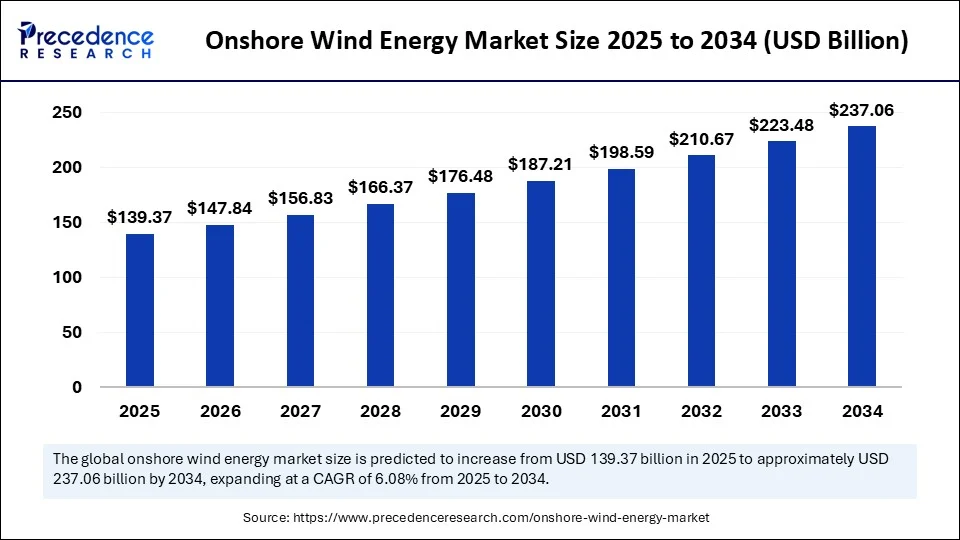
Precedence Research forecasts that the global onshore wind energy market will expand from $139.37 billion in 2025 to around $237.06 billion by 2034, registering a steady compound annual growth rate (CAGR) of 6.08 %. The sector already totaled $131.38 billion in revenue in 2024. Robust demand for carbon‑free power, generous government incentives and rapid advances in turbine technology are propelling investments in utility‑scale and distributed wind farms. In 2024, Asia Pacific accounted for about 40 % of global revenue, and Latin America is expected to register the fastest growth thanks to policy reforms and corporate power purchase agreements.

Quick Insights
- Market size: $131.38 billion in 2024; $139.37 billion in 2025; projected to reach $237.06 billion by 2034.
- CAGR: ~6.08 % from 2025 to 2034.
- Top region: Asia Pacific dominated with ~40 % share in 2024; the region’s revenue was roughly $52.55 billion in 2024 and is expected to reach ~$96.01 billion by 2034.
- Fastest‑growing region: Latin America – benefiting from Brazil and Chile’s aggressive expansion and favorable policies.
- Dominant turbine configuration: Horizontal‑axis wind turbines (HAWT) captured about 95 % of revenue in 2024 thanks to scalability and mature technology.
- Rated turbine capacity: The 3.0–5.0 MW class held the highest market share (~40 %) in 2024; >5.0 MW turbines will record the fastest growth as projects chase higher output.
- End‑user dominance: Utilities (vertically integrated) generated about 80 % of revenue in 2024; corporate power‑purchase agreements and captive models will accelerate in the forecast period.
- Installation type: New‑build greenfield projects represented roughly 70 % of installations in 2024.
- Operations & maintenance (O&M): Preventive maintenance accounted for ~50 % of O&M services in 2024; predictive/condition‑based maintenance is the fastest‑growing segment.
- North America: Market size exceeded $52.55 billion in 2024 and is projected to grow at ~6.21 % CAGR through 2034.
Decade‑long growth outlook
Precedence Research expects the global onshore wind energy market to scale rapidly as governments and corporations pursue net‑zero targets and energy security. With the global market predicted to nearly double from 2025 levels by 2034, onshore wind will continue to be the most cost‑effective renewable resource for many countries, delivering jobs and local manufacturing opportunities.
Revenue breakdown by region and segment
| Region/Segment | 2024 Revenue/Share | 2034 Projection & Growth Outlook |
| Global market | $131.38 B (2024) | $237.06 B by 2034 (CAGR 6.08 %) |
| Asia Pacific | $52.55 B in 2024, ~40 % share | $96.01 B by 2034; CAGR 6.21 % |
| North America | $52.55 B in 2024 | CAGR 6.21 % during 2025–2034 |
| Turbine configuration (2024) | HAWT: ~95 % share | VAWT segment grows at notable CAGR as urban applications expand |
| Rated capacity (2024) | 3.0–5.0 MW: ~40 % share | >5.0 MW segment to grow fastest due to efficiency and larger rotors |
| End‑user (2024) | Utilities: 80 % share | Corporate/Industrial segment to increase with power‑purchase agreements |
| Installation type (2024) | New‑build greenfield: ~70 % share | Repowering/Retrofit segment to grow rapidly |
| O&M service (2024) | Preventive maintenance: 50 % share | Predictive/CBM services to grow fastest due to AI and sensors |
What opportunities and trends will shape the onshore wind energy market?
The transition to clean energy is not merely an environmental imperative; it is becoming an economic driver. The onshore wind sector is benefiting from several converging trends:
- Renewable energy demand and climate goals. Rising concerns over greenhouse gas emissions and the urgency to mitigate climate change are prompting utilities and corporations to scale up wind projects. Governments are introducing renewable purchase obligations, feed‑in tariffs and tax credits to spur investment. According to Precedence Research, a surge in global renewable‑energy investment of $386 billion occurred in the first half of 2025.
- Technological advancements. Larger rotors, aerodynamic blades and high‑capacity towers have improved turbine efficiency. Horizontal‑axis wind turbines (HAWT) remain the dominant configuration because they capture more energy from prevailing winds, while vertical‑axis turbines (VAWT) are gaining traction in urban and residential settings due to lower maintenance and noise.
- Growing electricity demand. Rapid urbanization, industrial expansion and digitalization are increasing electricity demand worldwide. Onshore wind offers a scalable, cost‑competitive source of power that can be deployed quickly and integrated into both grid and off‑grid systems.
- Corporate procurement and power‑purchase agreements. Large corporations are entering long‑term contracts to secure renewable power and meet sustainability goals. These power‑purchase agreements (PPAs) provide stable revenue streams, attracting project developers and lenders.
- Green financing and investment models. The growth of green bonds, sustainable investment funds and concessional loans enables affordable capital for wind projects. Countries offering waivers for inter‑state transmission charges and accelerated depreciation are drawing private developers.
- Artificial intelligence in operations. AI‑powered predictive maintenance, wind forecasting and turbine optimization are reshaping O&M strategies. Vind AI’s January 2025 launch of a digital platform to design and assess onshore wind parks illustrates how data‑driven tools improve efficiency and community impact.
Expert view: resilience beyond the horizon
“Onshore wind energy stands at the intersection of climate urgency and economic opportunity,” said Arvind Menon, Principal Consultant at Precedence Research. “Our latest data show the global market nearly doubling to $237 billion by 2034. Countries and corporations are embracing 3–5 MW turbines for their optimal cost‑to‑output ratio, while projects featuring >5 MW units will surge ahead as technology matures. The widespread adoption of preventive and predictive maintenance, coupled with green‑finance models, points to a resilient and profitable future for wind developers.”
Regional analysis: Asia Pacific remains the powerhouse, Latin America gains momentum
Asia Pacific: From manufacturing hub to demand centre
With a 40 % market share in 2024, Asia Pacific leads global adoption. The region’s revenue reached $52.55 billion in 2024 and is forecast to almost double to $96.01 billion by 2034. China’s vast domestic wind industry, heavy investments and supportive policies make it the largest national market. India is also emerging as a global leader; its installed wind capacity rose from roughly 21 GW in 2014 to 51.3 GW by June 2025, adding 4.15 GW in FY 2024–25 and generating 78.21 billion units of electricity between April 2024 and February 2025. The government’s manufacturing programs and wind‑specific incentive schemes have propelled India to become the world’s fourth‑largest installer. Japan, Vietnam and other Southeast Asian economies are also investing in large‑scale wind farms amid rising electricity needs and localized supply chains.
North America: Mature market with steady growth
North America’s onshore wind market was worth $52.55 billion in 2024, expanding at a CAGR of 6.21 % during 2025–2034. The region benefits from tax credits, renewable portfolio standards and corporate procurement. Major players such as GE Renewable Energy, Siemens Gamesa and Vestas continue to deploy large‑scale projects across the United States and Canada.
Europe: Modernization and repowering
Europe is a mature yet evolving market. Germany’s third onshore wind auction launched in July 2025 to secure 3.44 GW of capacity, signalling renewed momentum. Britain unveiled its first national onshore wind strategy to meet its 2030 decarbonization targets. Repowering older turbines with >5 MW units is emerging as a cost‑effective way to increase output and reduce noise.
Latin America: Policy tailwinds and corporate PPAs
Latin America is the fastest‑growing region due to abundant resources, supportive policies and corporate procurement. Brazil’s investment in projects such as the Borborema II wind farm and agreements to supply data centres illustrate the region’s growth strategy. The Global Wind Energy Council notes that new projects and PPAs are vital for meeting net‑zero goals. Chile, Mexico and Argentina are also scaling up capacity.
Middle East & Africa: Emerging potential
Onshore wind in the Middle East and Africa is nascent but holds significant potential. Mega‑projects such as Oman Green Energy’s 10 GW wind farm, Morocco’s 7.5 GW AMUN project and Egypt’s 5 GW West Sohag installation highlight the region’s ambitions. Partnerships with European and Chinese developers are bringing technology and financing to these markets.
Read Also: Ophthalmic Drug CDMO Market Size, Forecast by 2034
Segmentation analysis: Technology, capacity and end‑users
Turbine configuration insights
- Horizontal‑axis wind turbines (HAWT) remained the dominant configuration with about 95 % revenue share in 2024 because of their scalability and maturity. HAWTs with aerodynamic blades capture more energy and are preferred in utility‑scale farms.
- Vertical‑axis wind turbines (VAWT) ranked second. Their ease of maintenance and high wind handling capabilities make them suitable for urban or residential installations. As urban micro‑grids proliferate, VAWTs could gain share at a notable CAGR.
Rated turbine capacity
- 3.0–5.0 MW turbines dominated with around 40 % share in 2024. Their balance of cost and output makes them ideal for large‑scale projects, particularly in Asia Pacific and North America.
- >5.0 MW turbines are projected to grow fastest as developers seek higher yields per installation. Advancements in materials, larger rotor diameters and decarbonization targets encourage adoption.
End‑user/offtaker insights
- Utilities (vertically integrated) generated about 80 % of revenue in 2024, leveraging their infrastructure, grid access and financial capacity to deploy large projects.
- Corporate/industrial (captive/PPA) customers will grow rapidly as companies lock in renewable power through PPAs to hedge price volatility and meet sustainability goals.
Installation type
- New‑build greenfield installations accounted for ~70 % of 2024 deployments. These projects tap high‑wind-resource areas and often receive expedited grid integration.
- Repowering/retrofit projects will record the fastest growth. Replacing outdated turbines with modern, higher‑capacity models increases output, lowers maintenance costs and improves community acceptance by reducing noise.
Operations & maintenance service type
- Preventive maintenance (scheduled) services dominated with ~50 % share in 2024 because regular inspections and lubrication reduce unplanned outages.
- Predictive/condition‑based maintenance (CBM) is the fastest‑growing segment. AI‑driven sensors and machine‑learning algorithms enable operators to anticipate faults, extend turbine life and boost energy output.
Latest breakthroughs and developments
- AI‑driven design tools. In January 2025, Norway’s Vind AI launched digital platforms that help design and assess onshore wind parks, incorporating environmental and community considerations. These tools enhance project planning and grid integration.
- Trade and security scrutiny. In August 2025, the U.S. Department of Commerce commenced a national security investigation into imported wind turbines and components under Section 232. The outcome could influence supply chains and domestic manufacturing incentives.
- Policy catalysts. Germany’s July 2025 auction aims to procure 3.44 GW of new onshore capacity. Britain announced its first onshore wind strategy, targeting a largely decarbonized electricity sector by 2030.
- Mega‑project pipeline. Several mega‑projects are slated for the coming decade: the Western Green Energy Hub (25 GW) and Asian Renewable Energy Hub (10.22 GW) in Australia, Chile’s H2 Magallanes project (10 GW), Oman’s Green Energy project (10 GW), Morocco’s AMUN project (7.5 GW), China’s Xinjiang Balikun project (7 GW) and Egypt’s West Sohag project (5 GW).
Challenges and cost pressures
Despite strong momentum, several headwinds persist:
- Grid integration hurdles. Integrating variable wind energy into aging or under‑developed grids poses technical challenges such as load balancing and frequency support. Investments in smart grids and energy storage are required to accommodate higher penetration levels.
- Capital intensity and supply chains. Large‑turbine manufacturing requires significant upfront capital and a steady supply of steel, copper and composites. The U.S. Section 232 investigation signals rising geopolitical risks for importers.
- Permitting and community acceptance. Long development timelines, land acquisition and community concerns can delay projects. Retrofits and modern designs that reduce noise and visual impact encourage acceptance.
Case study: India’s wind power trajectory
India exemplifies how industrial policy and innovation can unlock wind potential. The country’s installed wind capacity more than doubled from ~21 GW in 2014 to 51.3 GW by June 2025, with 4.15 GW added in FY 2024–25. Wind energy generated 78.21 billion units between April 2024 and February 2025, supplying 4.69 % of the nation’s electricity. India’s government has fostered local manufacturing, improved transmission networks and introduced competitive auctions. The country ranks fourth globally for installed wind power capacity and is experimenting with hybrid wind‑solar parks and offshore developments. Developers such as Suzlon Energy and Adani Green Energy are expanding turbine factories and integrated supply chains. India’s experience demonstrates how clear targets, domestic value addition and grid upgrades can accelerate renewable adoption.
Call to action: Download your sample report or speak with our experts
To explore the full data set, methodology and market segmentation, download a free sample of the Onshore Wind Energy Market report from Precedence Research or schedule a meeting with our analysts. Whether you’re an investor evaluating green bonds, a developer planning a mega‑project or a corporate sustainability officer seeking renewable power, our tailored insights and competitive intelligence will empower you to make informed decisions.
Get your sample report: /onshore-wind-energy-market
Schedule a meeting: Schedule a meeting
About Precedence Research
Precedence Research is a global market research and consulting firm serving Fortune 500 companies, start‑ups and governments across more than 30 industries. Our proprietary databases and seasoned analysts provide actionable insights, forecasting and strategic advice. With offices in Canada, India and the United States, we blend local intelligence with global perspectives to help clients navigate market complexity.
For media inquiries, custom research requests or bulk purchases, contact:
Precedence Research
Email: sales@
Website: www.
LinkedIn: Precedence Research
Note: This press release is based on data available as of September 8 2025. It does not include proprietary or gated content beyond the cited sources.