

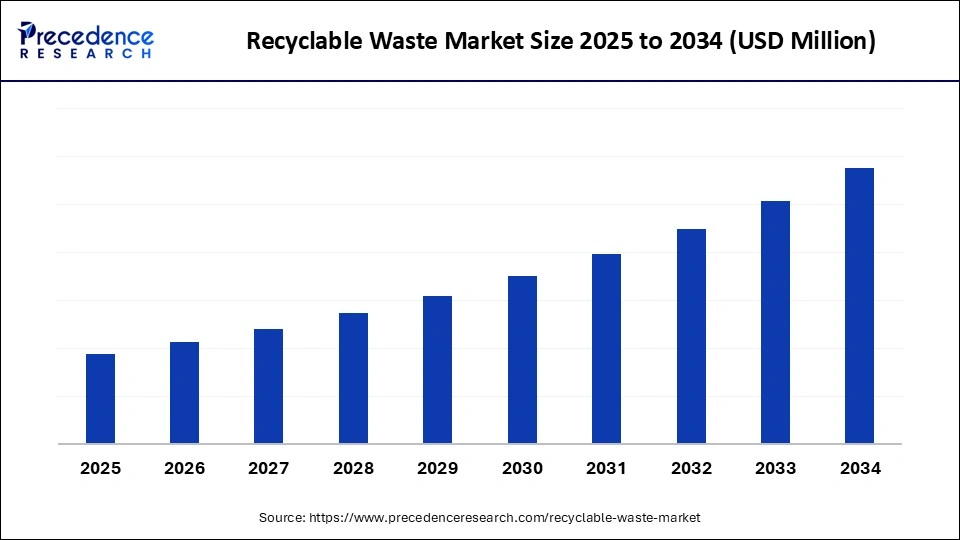
The global recyclable waste market is primed for sustained growth, projected to expand significantly from its 2024 baseline as environmental regulations, sustainability mandates, and consumer demand drive renewed interest in circular economy strategies. The market is forecast to grow at a CAGR of 7.2%, with Asia-Pacific emerging as the fastest-growing region and substantial momentum in materials like plastics and e-waste components (Precedence Research). Core growth drivers include enhanced recycling technologies, AI-driven sorting and logistics, and supportive regulatory frameworks investing in circularity.

Quick Insights
-
2024 Market Value Baseline: Dominated by North America with a 32.80% share
-
Fastest-growing region: Asia-Pacific, with a projected 7.2% CAGR
-
Material Segment: Paper & cardboard lead with 34.60% share in 2024
-
Fastest-growing material: Plastics, with a 7.80% CAGR forecasts
-
Source Segment: Back-of-house operations contribute 42.10% share in 2024
-
Fastest-growing source: Retail floor segment with 6.90% CAGR projected
-
Recycled Material Segment: Recycled paper products dominate with 33.40% share in 2024
-
Fastest-growing recycled material: Recycled e-waste components, with 8.60% CAGR expected
Revenue Table (Segment Breakdown)
| Segment Category | Key Insight |
|---|---|
| Material | Paper & cardboard—34.60% share (2024); plastics are the fastest-growing (7.80% CAGR). |
| Source | Back-of-house operations—42.10% share (2024); Retail floor fastest-growing (6.90% CAGR) |
| Recycled Material | Recycled paper products—33.40% share (2024); Recycled e-waste is the fastest-growing (8.60% CAGR) |
| Regional | North America led (32.80% share, 2024); Asia-Pacific is the fastest-growing (7.2% CAGR). |
Opportunity & Trend Spotlight
What if AI could revolutionize recycling?
Artificial intelligence is quickly redefining the recyclable waste ecosystem. From optimizing sorting accuracy and reducing contamination to streamlining logistics with smart routing and enhancing price forecasting—AI is increasing profitability and efficiency, while bolstering circular economy outcomes
Expert Quote
“Our analysis highlights that AI and advanced material-specific technologies are not just enhancing recycling efficiency—they’re unlocking entirely new value pools in the waste economy,” said Dr. Aisha Mehta, Principal Consultant at Precedence Research. “From urban retail floor waste to emerging e-waste streams, companies that integrate data-driven recycling strategies will emerge as leaders in the circular transformation.”
Regional & Segmentation Analysis
North America remains the largest market in absolute terms, buoyed by mature recycling infrastructure, well-established policies, and corporate sustainability programs . In contrast, Asia-Pacific is the growth engine, with technology adoption and regulatory pressures fueling a 7.2% CAGR through 2034.
-
By Material:
-
Paper & Cardboard dominate due to high recyclability and value across industrial applications.
-
Plastics are accelerating fast, thanks to investments in chemical/mechanical recycling and rising sustainable packaging demand
-
-
By Source:
-
Back-of-house operations lead in volume due to consistent supply from logistics and storage.
-
Retail Floor has high growth—driven by e-commerce and consumer goods churn generating recyclable packaging.
-
-
By Recycled Material:
-
Recycled Paper remains dominant in usage.
-
Recycled E-Waste Components offer the highest growth potential with rapid tech turnover and embedded high-value metals.
-
Emerging Breakthroughs from Industry Leaders
-
Toyota Tsusho America acquired Radius Recycling in July 2025, strengthening its recycling footprint while retaining local operations and leadership.
-
In November 2024, Neste, Alterra, and Technip Energies partnered to standardize modular chemical recycling technologies—accelerating scalable circular plastics solutions.
-
Fortum Recycling & Waste introduced biodegradable plastics made using carbon captured from waste incineration at its plant in Finland—an innovative carbon-capture and utilization (CCU) synergy.
Challenges & Cost Pressures
Despite innovation, high labour and energy costs remain headwinds—sorting remains labor-intensive, and automated systems are energy-hungry. Moreover, inconsistent regulations and limited infrastructure in emerging regions continue to bottleneck optimized recycling flows. Addressing these challenges will require public-private collaboration and technological investment.
Case Study
Radius Recycling (Toyota Tsusho America) – Post-acquisition, Radius is leveraging Toyota’s global logistics expertise while expanding its capacity for advanced materials processing. Early synergies indicate improved throughput and access to emerging streams like retail packaging and e-waste, illustrating how strategic integration can uplift recyclability and operational scale
About Precedence Research
Precedence Research is a global market intelligence and consulting firm recognized for delivering strategic insights across critical growth sectors. With expertise in recyclable materials, sustainability, and circular economy dynamics, we empower clients to make data-driven decisions that foster resilience and innovation.
Contact Information:
-
USA: +1 804 441 9344
-
APAC: +61 485 981 310 • +91 87933 22019
-
Europe: +44 7383 092 044
-
Email: sales@precedenceresearch.com