
Small Caliber Ammunition Market Size 2035: Fueling the Future of Global Defense
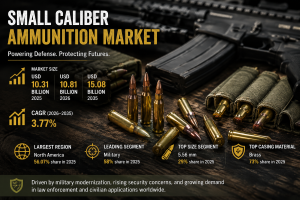
The global small caliber ammunition market is projected to grow from USD 10.81 billion in 2026 to approximately USD 15.08 billion by 2035, expanding at a CAGR of 3.77%. The market’s growth is being fueled by rising defense expenditures, military modernization programs, growing civilian firearm ownership, and technological advancements in ammunition manufacturing.
In an increasingly uncertain global security environment, ammunition remains one of the most critical resources for military forces, law enforcement agencies, and civilian firearm users. While advanced weapons systems often dominate defense headlines, the effectiveness of those systems ultimately depends on the availability of reliable ammunition.
Among all ammunition categories, small caliber ammunition continues to hold strategic importance due to its widespread use in infantry weapons, handguns, assault rifles, and training programs. As nations strengthen their defense capabilities and security forces modernize their arsenals, demand for small caliber ammunition is expected to remain strong over the next decade.
Why Small Caliber Ammunition Matters More Than Ever
- Small caliber ammunition serves as the primary ammunition type used by military personnel, police officers, security agencies, and civilian firearm owners across the world. It powers everything from standard infantry rifles and handguns to tactical weapons used in specialized operations.
- Its importance extends beyond combat situations. Small caliber rounds are consumed in large quantities during military training exercises, law enforcement drills, competitive shooting events, hunting activities, and personal defense applications.
- As governments continue investing in national security and combat readiness, ammunition procurement remains a top priority within defense budgets.
Small Caliber Ammunition Market at a Glance
The industry is entering a new phase of growth driven by evolving security threats and defense modernization initiatives.
Key highlights include:
- Market value reached USD 10.31 billion in 2025
- Expected to reach USD 15.08 billion by 2035
- North America accounted for 56.07% of global revenue in 2025
- Military applications generated 58% of total market demand
- Brass casings represented 73% of the market
- Polymer and hybrid casings are emerging as the fastest-growing material segment
- 5.56 mm ammunition remained the most widely used caliber worldwide
The Defense Industry’s Continuous Need for Ammunition
- Unlike many defense products that are purchased once and used for years, ammunition is a consumable resource. Every training session, military exercise, border patrol mission, and operational deployment requires a constant supply of ammunition.
- This creates recurring demand that supports long-term market stability.
- Many countries are now rebuilding strategic stockpiles while simultaneously upgrading infantry weapon systems. As a result, ammunition manufacturers are receiving increased orders from defense ministries looking to improve combat readiness.
- Recent geopolitical developments across Europe, Asia-Pacific, and the Middle East have further accelerated procurement activities.
How Technology Is Transforming Ammunition Manufacturing
The ammunition industry is no longer solely focused on mass production. Manufacturers are increasingly investing in advanced technologies that improve accuracy, safety, and operational performance.
Modern developments include:
Artificial Intelligence and Smart Manufacturing
- AI-powered systems are helping ammunition manufacturers optimize production lines, reduce defects, and improve quality assurance processes.
- Advanced algorithms can monitor equipment performance in real time, predict maintenance requirements, and identify manufacturing inconsistencies before they affect production output.
Enhanced Ballistics
- Defense organizations increasingly demand ammunition capable of delivering better accuracy, penetration, and consistency under diverse combat conditions.
- This has encouraged manufacturers to develop improved projectile designs and advanced propellant formulations.
Lightweight Ammunition Solutions
- Reducing soldier load has become a major objective for military planners.
- As a result, lightweight polymer and hybrid ammunition casings are attracting significant attention because they help reduce carrying weight while maintaining battlefield performance.
Sustainability is Reshaping Industry Priorities
Environmental regulations are beginning to influence ammunition design across both military and civilian sectors.
Traditional lead-based ammunition is facing increasing scrutiny due to environmental concerns. In response, manufacturers are developing environmentally responsible alternatives that deliver comparable performance while reducing ecological impact.
Current sustainability initiatives include:
- Lead-free projectiles
- Recyclable casing materials
- Reduced-emission manufacturing processes
- Lightweight polymer technologies
- Environmentally compliant ammunition formulations
These developments are expected to become increasingly important over the coming decade.
Why 5.56 mm Continues to Lead the Market
- Among all caliber categories, 5.56 mm ammunition remains the dominant segment.
- Its popularity stems from its versatility and widespread adoption by military organizations worldwide. The caliber provides a balance of accuracy, controllability, and effective range while allowing soldiers to carry more ammunition compared to larger calibers.
- The global standardization of 5.56 mm ammunition among NATO members and allied nations has further strengthened its market position.
- Military modernization programs in North America, Europe, Asia-Pacific, and the Middle East continue to support strong demand for this caliber.
Military Applications Remain the Industry’s Largest Revenue Source
The military segment accounted for more than half of global market revenue in 2025 and is expected to maintain its leadership position throughout the forecast period.
Several factors support this dominance:
- Expanding defense budgets
- Growing geopolitical tensions
- Border security requirements
- Counterterrorism operations
- Large-scale training exercises
- Strategic ammunition stockpiling
Many governments are prioritizing ammunition procurement as part of broader military readiness programs, creating sustained opportunities for manufacturers.
Material Innovation Driving Competitive Advantage
Brass: The Industry Standard
Brass remains the preferred casing material because of its proven reliability, durability, and corrosion resistance.
Its ability to withstand high-pressure firing conditions while maintaining consistent performance makes it the material of choice for military, law enforcement, and civilian applications.
Polymer and Hybrid Casings: The Future of Ammunition
While brass dominates current production, polymer and hybrid casings are rapidly gaining momentum.
These materials offer:
- Reduced ammunition weight
- Lower transportation costs
- Improved corrosion resistance
- Enhanced thermal performance
- Potential manufacturing efficiencies
As military forces seek lighter equipment solutions, adoption of polymer technologies is expected to accelerate.
Read More: Aluminum Market
Regional Outlook
North America: Global Market Leader
- North America continues to dominate the global small caliber ammunition market.
- The United States remains the largest contributor to global ammunition demand, supported by both military procurement and commercial firearm activity.
Asia-Pacific: The Fastest-Growing Opportunity
- Asia-Pacific is expected to register the strongest growth during the forecast period.
- Countries such as India, China, South Korea, and Australia are investing heavily in military modernization and domestic defense manufacturing.
- The region’s expanding security requirements and growing defense budgets are creating substantial opportunities for ammunition suppliers.
Europe: Precision and Sustainability Focus
- European countries continue investing in advanced ammunition technologies while maintaining strict environmental and regulatory standards.
- Growing emphasis on lead-free ammunition and precision-engineered rounds is driving innovation across the region.
Top Leading companies
- Capacity expansion
- Product innovation
- Government contracts
- Sustainability initiatives
- Advanced manufacturing technologies
Major market participants include Northrop Grumman, General Dynamics, BAE Systems, Nammo, Olin Corporation, Elbit Systems, CBC Global Ammunition, RUAG Group, MESKO, and Remington Arms.
Future Outlook
- The future of the small caliber ammunition market will be shaped by three major forces: defense modernization, technological innovation, and sustainability.
- Governments are expected to continue increasing investments in military preparedness, while manufacturers focus on delivering lighter, smarter, and more environmentally responsible ammunition solutions.
- As geopolitical uncertainties persist and military modernization programs accelerate worldwide, small caliber ammunition will remain an essential component of national defense and security infrastructure.
- For manufacturers capable of balancing performance, innovation, and sustainability, the next decade presents significant opportunities for growth and market expansion.
Get this report to explore global market size, share, CAGR, and trends, featuring detailed segmental analysis and an insightful competitive landscape overview: https://www.precedenceresearch.com/sample/2209
You can place an order or ask any questions. Please feel free to contact us at sales@precedenceresearch.com |+1 804 441 9344