

The U.S. battery logistics market is projected to reach USD 11.43 billion by 2035, driven by EV growth, battery manufacturing expansion, and recycling initiatives.
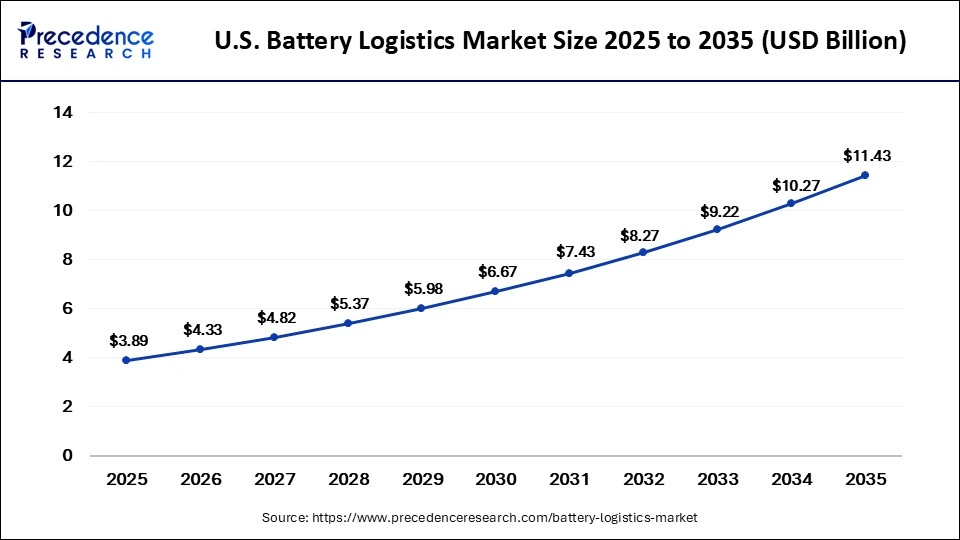

U.S. Battery Logistics Market Overview
The U.S. battery logistics market is witnessing remarkable growth as the country accelerates investments in electric vehicles (EVs), battery manufacturing, and renewable energy storage systems. According to recent industry estimates, the market size was valued at USD 3.89 billion in 2025 and is expected to grow from USD 4.33 billion in 2026 to approximately USD 11.43 billion by 2035, registering a CAGR of 11.38% during the forecast period.
Battery logistics encompasses transportation, warehousing, inventory management, packaging, distribution, reverse logistics, and recycling services. These operations are critical for ensuring the safe and efficient movement of batteries throughout the supply chain while complying with stringent safety regulations.
Read Also: AI Hallucination Detection Market
Key Market Highlights
- Market size reached USD 3.89 billion in 2025.
- Expected to attain USD 11.43 billion by 2035.
- CAGR projected at 11.38% from 2026 to 2035.
- Lithium-ion batteries dominated the market in 2025.
- Transportation services accounted for the largest logistics service segment.
- Road transportation remained the preferred logistics mode.
- Electric vehicles emerged as the leading application segment.
- Automotive OEMs represented the largest end-user category.
Rising EV Production Driving Market Growth
The rapid expansion of the electric vehicle industry is a major factor fueling demand for battery logistics services across the United States. As automakers continue increasing EV production and battery manufacturing facilities expand nationwide, the need for specialized transportation and storage solutions has surged.
Battery gigafactories are being established across multiple states, creating a strong requirement for efficient logistics networks capable of moving raw materials, battery cells, modules, and finished battery packs safely and cost-effectively.
Additionally, growing deployment of battery energy storage systems (BESS) is further supporting logistics demand across the energy sector.
How Artificial Intelligence is Transforming Battery Logistics
Artificial Intelligence (AI) is becoming an essential tool for logistics providers managing battery supply chains. AI-powered systems help companies optimize transportation routes, improve inventory visibility, forecast demand, and reduce operational costs.
Advanced AI technologies are also enabling:
- Real-time battery monitoring
- Predictive maintenance
- Warehouse automation
- Enhanced shipment tracking
- Improved safety compliance
The integration of AI with IoT-enabled devices is helping logistics providers improve supply chain resilience and traceability while minimizing transportation delays.
Government Initiatives Strengthening the Battery Supply Chain
The U.S. government is actively supporting domestic battery manufacturing and logistics through policy initiatives and financial incentives.
Programs under the Infrastructure Investment and Jobs Act (IIJA) and the Inflation Reduction Act (IRA) are encouraging investments in:
- Battery manufacturing facilities
- Critical mineral processing plants
- Battery recycling infrastructure
- EV supply chain development
The U.S. Department of Energy (DOE) has also launched substantial funding initiatives aimed at expanding battery production and recycling capabilities, further increasing demand for transportation and logistics services.
Market Challenges
Strict Safety Regulations
Lithium-ion batteries are classified as hazardous materials and require specialized packaging, transportation procedures, and storage conditions.
Compliance challenges include:
- Hazardous material handling requirements
- Regulatory documentation
- Specialized employee training
- Higher transportation costs
- Shipment delays due to compliance checks
These factors continue to create operational challenges for logistics providers.
Emerging Opportunities in Battery Recycling
Battery recycling is emerging as one of the most promising growth areas within the logistics ecosystem.
As millions of EV batteries approach the end of their useful life, logistics companies are expanding reverse logistics capabilities to support:
- Battery collection
- Transportation to recycling facilities
- Temporary storage
- Second-life battery distribution
The growing circular economy approach is expected to generate significant opportunities for specialized battery logistics providers over the coming decade.
Segment Analysis
By Battery Type
The Lithium-Ion Batteries segment dominated the market in 2025 due to widespread adoption across EVs, consumer electronics, and energy storage systems.
Meanwhile, Flow Batteries are anticipated to witness the fastest growth rate due to increasing investments in grid-scale energy storage projects.
By Logistics Service
Transportation Services accounted for the largest market share in 2025 because of the high volume movement of battery materials and finished products.
The Warehousing & Storage segment is projected to grow rapidly due to rising investments in specialized battery storage infrastructure.
By Transportation Mode
Road Transportation remained the leading transportation mode owing to its flexibility and extensive nationwide network.
The Multimodal Transport segment is expected to experience strong growth as companies increasingly combine road, rail, air, and sea freight solutions to optimize costs and efficiency.
By Application
The Electric Vehicles (EVs) segment led the market in 2025, supported by strong EV sales and growing domestic battery production.
The Energy Storage Systems segment is forecast to grow significantly due to increasing renewable energy integration and grid modernization efforts.
By Battery Lifecycle
Finished Battery Distribution dominated the market as battery manufacturers increased shipments to automakers and energy storage providers.
However, Recycling & Second-Life Logistics is expected to register the fastest growth owing to increasing sustainability initiatives.
By End User
Automotive OEMs represented the largest end-user segment due to surging EV production.
The Energy & Utility Companies segment is anticipated to grow rapidly as utilities deploy more battery energy storage systems.
Regional Insights
California
California continues to lead the U.S. battery logistics market due to its strong EV ecosystem, battery manufacturing investments, and ambitious clean energy policies.
Texas
Texas is emerging as a major battery logistics hub because of its growing battery production capacity, renewable energy projects, and strategic transportation infrastructure.
Massachusetts
Massachusetts is witnessing growth through investments in energy storage research and renewable energy technologies.
North Carolina
North Carolina is becoming an attractive destination for battery manufacturing projects, creating new logistics opportunities throughout the supply chain.
Competitive Landscape
The U.S. battery logistics market remains moderately consolidated with global logistics companies investing heavily in battery-specific infrastructure and digital supply chain solutions.
Key strategies adopted by market participants include:
- Expansion of battery storage facilities
- Development of hazardous material transportation capabilities
- Real-time shipment monitoring
- Multimodal transportation solutions
- Battery recycling logistics networks
Leading Companies
- DHL Supply Chain
- FedEx Corporation
- UPS Supply Chain Solutions
- Kuehne+Nagel
- DB Schenker
- DSV A/S
- CEVA Logistics
- GEODIS
- Ryder System Inc.
- Expeditors International
- C.H. Robinson
- XPO Logistics
- J.B. Hunt Transport Services
- Nippon Express Holdings
- Lineage Logistics
Recent Industry Developments
- In June 2026, Maersk Logistics & Services USA launched a dedicated lithium-ion battery transportation solution across North America.
- In October 2025, ITS Logistics introduced Battery Logistics Hubs designed for EV and battery supply chains.
- In April 2026, 6K Energy partnered with CRG Defense to strengthen domestic battery supply chain operations.
Conclusion
The U.S. battery logistics market is entering a period of accelerated expansion fueled by rising EV production, growing battery manufacturing investments, and increased deployment of energy storage systems. Advances in AI-driven logistics technologies, expanding recycling infrastructure, and supportive government policies are creating a robust environment for market growth. As battery demand continues to rise, logistics providers that invest in specialized transportation, storage, and recycling solutions will be well-positioned to capitalize on emerging opportunities.
Get a Sample Copy: https://www.precedenceresearch.com/sample/8521
For inquiries regarding discounts, bulk purchases, or customization requests, please contact us at sales@precedenceresearch.com