
U.S. Concierge Medicine Market Size, Growth Trends and AI-Powered Healthcare Innovations Forecast 2026 to 2035
The U.S. concierge medicine market is entering a new phase of transformation as artificial intelligence (AI), digital health technologies, and personalized healthcare models redefine the patient experience. The market was valued at USD 6.55 billion in 2025 and is expected to grow to USD 12.75 billion by 2035, registering a CAGR of 6.88% from 2026 to 2035.
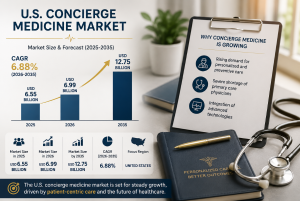
As healthcare consumers increasingly seek preventive care, same-day appointments, longer physician consultations, and technology-enabled health management, concierge medicine providers are integrating AI-powered diagnostics, virtual care, remote patient monitoring, and predictive analytics to deliver highly personalized healthcare.
Download the Sample: https://www.precedenceresearch.com/sample/3521
Concierge Medicine: A New Era of Personalized Healthcare
- The U.S. healthcare system has experienced growing pressure from physician shortages, increasing patient volumes, administrative burdens, and rising healthcare costs. These challenges have encouraged both physicians and patients to seek alternative care delivery models that emphasize quality over quantity.
- Concierge medicine has emerged as one of the fastest-growing personalized healthcare models by offering patients premium access to physicians through annual or monthly membership programs. Rather than managing thousands of patients, concierge physicians typically maintain significantly smaller patient panels, allowing them to spend more time with each individual and provide customized healthcare solutions.
- Patients benefit from same-day appointments, longer consultation times, 24/7 physician communication, preventive screenings, personalized wellness plans, chronic disease management, nutritional counseling, and coordinated specialty care. Physicians, in turn, benefit from reduced administrative burdens, greater clinical autonomy, improved work-life balance, and stronger long-term relationships with patients.
- As digital transformation accelerates across healthcare, concierge medicine is increasingly integrating AI-powered technologies to further personalize care delivery, improve operational efficiency, and support better health outcomes.
How Artificial Intelligence is Transforming Concierge Medicine
- Artificial intelligence is redefining healthcare by enabling physicians to make faster, more accurate clinical decisions while improving patient engagement and streamlining medical operations.
- Unlike conventional healthcare environments that often rely on reactive treatment after illness develops, AI allows concierge medicine providers to adopt a proactive approach by continuously monitoring patient health, identifying disease risks, and recommending preventive interventions before serious complications arise.
- Machine learning algorithms can process millions of clinical records, laboratory results, wearable device data, imaging studies, lifestyle factors, and genetic information within seconds. This enables physicians to detect hidden health risks, personalize treatment strategies, and monitor patient progress more effectively than ever before.
- AI is also reducing administrative burdens by automating appointment scheduling, medical documentation, prescription management, insurance verification, billing, and electronic health record updates. These efficiencies allow physicians to dedicate more time to patient care instead of paperwork, enhancing the overall concierge healthcare experience.
Supporting the Shift Toward Preventive and Personalized Healthcare
- Several healthcare trends continue driving the rapid growth of concierge medicine across the United States.
- Consumers are increasingly prioritizing preventive healthcare over reactive treatment, seeking regular wellness assessments, comprehensive health evaluations, and long-term disease prevention strategies. At the same time, an aging population and the rising prevalence of chronic diseases such as diabetes, cardiovascular disorders, obesity, hypertension, and mental health conditions have increased demand for continuous physician access and individualized care.
- Growing dissatisfaction with long wait times, rushed appointments, and fragmented healthcare experiences has further encouraged patients to adopt concierge medicine memberships. Employers are also expanding executive healthcare programs that provide concierge services to improve employee well-being and productivity.
- Artificial intelligence supports these evolving healthcare needs by enabling predictive health monitoring, personalized care recommendations, remote patient management, and data-driven clinical decision-making.
AI Use Cases in the U.S. Concierge Medicine Market
Personalized Preventive Healthcare
- One of the most significant applications of AI in concierge medicine is personalized preventive care.
- AI platforms analyze extensive patient information including medical history, laboratory findings, wearable device data, family history, nutrition, exercise habits, sleep quality, medication adherence, and lifestyle factors. Based on these insights, physicians can create highly customized healthcare plans that focus on disease prevention rather than simply treating existing conditions.
- Patients receive individualized recommendations for nutrition, exercise, preventive screenings, vaccinations, medication optimization, and lifestyle improvements that align with their specific health risks and wellness goals.
Intelligent Clinical Decision Support
- Modern AI systems serve as powerful decision-support tools for concierge physicians.
- By rapidly analyzing patient symptoms, diagnostic imaging, laboratory results, clinical guidelines, and medical literature, AI assists physicians in identifying potential diagnoses, recommending evidence-based treatments, and recognizing early signs of disease progression.
- Rather than replacing physicians, AI enhances clinical expertise by providing data-driven insights that improve diagnostic confidence and treatment precision.
Remote Patient Monitoring
- Remote patient monitoring has become one of the fastest-growing areas of concierge medicine.
- Wearable devices such as smartwatches, continuous glucose monitors, blood pressure monitors, and fitness trackers continuously collect patient health data throughout the day.
- Artificial intelligence analyzes these data streams in real time, identifying abnormal trends before they become serious medical events. Physicians can intervene early when AI detects irregular heart rhythms, uncontrolled blood glucose, elevated blood pressure, declining physical activity, or poor sleep quality.
- This proactive care model significantly improves chronic disease management while reducing unnecessary hospitalizations.
Virtual Health Assistants and Digital Care
- AI-powered virtual assistants have transformed patient communication within concierge practices.
- Patients can schedule appointments, receive medication reminders, access laboratory reports, ask health-related questions, obtain wellness recommendations, and communicate with healthcare teams around the clock through intelligent digital assistants.
- These virtual healthcare companions improve patient engagement while reducing administrative workload for physicians and clinical staff.
Administrative Workflow Automation
- Administrative complexity remains one of the biggest challenges facing healthcare providers.
- Artificial intelligence automates routine tasks including appointment scheduling, billing verification, electronic documentation, prescription refills, coding assistance, insurance processing, and patient follow-up communications.
- By reducing paperwork and repetitive administrative responsibilities, concierge physicians can devote more time to personalized patient care, which remains the core value proposition of membership-based healthcare.
Population Health Analytics
- Machine learning algorithms help concierge practices identify patient populations at elevated risk for chronic illnesses.
- Using predictive analytics, physicians can proactively recommend lifestyle interventions, preventive screenings, medication adjustments, and specialist referrals before disease progression occurs.
- This data-driven approach improves long-term health outcomes while lowering overall healthcare costs.
Industry Examples of AI Adoption
- Numerous organizations across the U.S. concierge medicine ecosystem are already integrating AI technologies into their healthcare delivery models.
Concierge Primary Care Practices
- Leading concierge providers utilize AI-powered analytics to personalize wellness programs, monitor chronic diseases, and optimize preventive care strategies for individual patients.
Digital Healthcare Platforms
- Technology-enabled healthcare companies combine telemedicine, AI-assisted diagnostics, electronic health records, and virtual consultations to deliver seamless personalized healthcare experiences.
Remote Monitoring Companies
- Healthcare providers increasingly integrate wearable medical devices with AI analytics to continuously monitor patient health, enabling earlier interventions and better long-term disease management.
Executive Health Programs
- Corporate healthcare providers leverage AI to create customized executive wellness assessments, health risk evaluations, preventive screening programs, and personalized healthcare plans for employees and business leaders.
Read More: Whey Protein Market
The Future Impact of AI on the U.S. Concierge Medicine Market
- Artificial intelligence is expected to become the foundation of next-generation concierge healthcare over the coming decade.
- Future AI platforms will integrate wearable technologies, genomic testing, laboratory diagnostics, environmental factors, lifestyle behaviors, and real-time health monitoring into comprehensive patient profiles capable of predicting disease risk with unprecedented accuracy.
- Healthcare providers will increasingly utilize conversational AI, intelligent virtual nurses, automated clinical documentation, digital therapeutics, and predictive analytics to improve patient engagement while reducing physician workload.
- AI will also accelerate precision medicine by enabling individualized treatment recommendations based on genetics, biomarkers, and personal health history. Preventive healthcare will become increasingly proactive rather than reactive, allowing physicians to intervene long before diseases develop into serious medical conditions.
- At the operational level, AI-powered automation will continue reducing administrative complexity, improving regulatory compliance, optimizing appointment scheduling, and enhancing practice management efficiency.
Future Outlook
The U.S. concierge medicine market is rapidly evolving into a technology-enabled, patient-centric healthcare ecosystem where personalized care, preventive medicine, and digital innovation work together to improve health outcomes. Artificial intelligence is serving as the primary catalyst behind this transformation by enabling smarter clinical decisions, continuous health monitoring, precision wellness planning, and highly efficient healthcare delivery.
As demand for premium healthcare experiences continues to grow among individuals, employers, and aging populations, concierge medicine providers that successfully integrate AI into clinical practice will be better positioned to deliver superior patient satisfaction, improve physician productivity, reduce healthcare costs, and strengthen long-term competitive advantage.
Over the next decade, AI will not simply enhance concierge medicine it will fundamentally redefine how personalized healthcare is delivered across the United States, creating a more proactive, connected, and data-driven healthcare ecosystem for both patients and providers.
For report inquiries and custom research requirements, please contact our analyst team at sales@precedenceresearch.com | +1 804 441 9344.