

The global water purifier market is entering a new era of technological transformation as artificial intelligence (AI), Internet of Things (IoT), and smart filtration technologies reshape how households, businesses, and industries access safe drinking water. The market was valued at USD 38 billion in 2025 and is projected to reach USD 79.85 billion by 2035, expanding at a CAGR of 7.71% from 2026 to 2035.
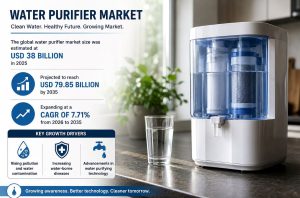

Growing concerns over water pollution, rising incidences of waterborne diseases, rapid urbanization, industrial contamination, and increasing consumer awareness regarding preventive healthcare are accelerating the adoption of advanced water purification systems across the globe. At the same time, manufacturers are integrating AI-powered monitoring systems, predictive maintenance capabilities, intelligent sensors, and connected mobile applications to transform conventional water purifiers into smart water management systems.
As governments strengthen drinking water regulations and consumers demand greater transparency regarding water quality, AI-enabled purification technologies are helping deliver safer, more efficient, and personalized water treatment solutions for residential, commercial, and industrial users.
Download the Sample: https://www.precedenceresearch.com/sample/2975
Water Purification Enters the Era of Smart Connected Technology
- Access to clean drinking water has become one of the world’s most pressing public health priorities. Population growth, rapid industrialization, agricultural runoff, aging municipal infrastructure, and climate change have significantly increased concerns surrounding water quality in both developed and developing economies.
- Consumers are no longer satisfied with basic filtration systems that simply remove visible impurities. Modern buyers expect purification systems capable of eliminating bacteria, viruses, heavy metals, pesticides, pharmaceutical residues, PFAS chemicals, chlorine, microplastics, and other emerging contaminants while maintaining essential minerals and improving taste.
- Water purifier manufacturers are responding to these evolving expectations by introducing advanced multi-stage filtration systems combining Reverse Osmosis (RO), Ultraviolet (UV), Ultrafiltration (UF), activated carbon, nanofiltration, mineral enhancement technologies, and AI-powered digital monitoring.
- Unlike traditional water purifiers that operate on fixed filtration cycles, today’s intelligent purification systems continuously analyze incoming water quality, optimize purification processes, notify users about filter performance, and provide real-time insights through connected mobile applications.
- This evolution is transforming water purification from a reactive household appliance into an intelligent health management solution that delivers safer water while improving convenience, operational efficiency, and sustainability.
How Artificial Intelligence is Transforming the Water Purifier Market
- Artificial intelligence is fundamentally changing the water purification industry by enabling systems to monitor, analyze, predict, and optimize water quality in real time.
- Traditional purification systems typically follow fixed operational settings regardless of seasonal changes, regional water quality variations, or household consumption patterns. AI removes these limitations by allowing purification systems to make intelligent decisions based on continuous data analysis.
- Smart sensors embedded within modern water purifiers monitor numerous parameters, including Total Dissolved Solids (TDS), pH levels, turbidity, temperature, pressure, flow rate, dissolved contaminants, filter health, and overall purification efficiency. Machine learning algorithms continuously evaluate these data points and automatically adjust filtration intensity to maintain optimal water quality while reducing unnecessary energy and water consumption.
- Artificial intelligence also enables predictive maintenance by forecasting filter replacement schedules before performance declines. Rather than relying on fixed maintenance intervals, AI determines the actual condition of filtration components based on usage, incoming water quality, and operational history, helping consumers reduce maintenance costs while ensuring consistent purification performance.
- For manufacturers and service providers, AI significantly improves customer support through automated diagnostics, remote troubleshooting, software updates, and proactive service scheduling. These capabilities enhance customer satisfaction while reducing maintenance expenses and extending product lifespan.
Supporting the Global Demand for Safe Drinking Water
Several long-term global trends continue driving the expansion of the water purifier market.
- Rapid urbanization has increased pressure on municipal water infrastructure, while industrial growth has introduced new contaminants into freshwater sources. Heavy metals, pesticides, industrial chemicals, pharmaceutical residues, and microbial pollutants continue to pose significant public health risks in many regions.
- At the same time, increasing awareness regarding waterborne diseases such as cholera, typhoid, dysentery, hepatitis A, diarrhea, and gastrointestinal infections has encouraged consumers to invest in advanced purification technologies capable of delivering consistently safe drinking water.
- Governments around the world are strengthening water quality standards and investing heavily in clean water initiatives. Programs aimed at improving drinking water infrastructure, expanding wastewater recycling, and increasing access to safe water are creating significant growth opportunities for water purifier manufacturers.
- Rising disposable incomes across emerging economies are further supporting market expansion. As household purchasing power improves, consumers are increasingly investing in premium home appliances that promote healthier lifestyles, including smart water purification systems equipped with advanced filtration technologies.
- Commercial establishments such as offices, hospitals, schools, hotels, restaurants, educational institutions, manufacturing facilities, and healthcare centers are also adopting sophisticated purification systems to comply with health regulations while ensuring safe drinking water for employees, customers, and patients.
How Artificial Intelligence is Revolutionizing the Water Purifier Market
Artificial intelligence is rapidly transforming water purification from a traditional filtration process into an intelligent water quality management ecosystem. By combining AI with IoT sensors, cloud computing, machine learning, and advanced filtration technologies, manufacturers are enabling water purifiers to continuously monitor water quality, predict maintenance needs, optimize purification performance, and provide consumers with real-time insights.
Unlike conventional systems that operate using fixed filtration settings, AI-powered water purifiers analyze changing water conditions and automatically adjust purification parameters based on contamination levels, usage patterns, and environmental conditions. This intelligent approach enhances purification efficiency while reducing water wastage, energy consumption, and maintenance costs.
As demand for safer drinking water and smart home technologies continues to grow, AI is becoming one of the most important competitive differentiators across the global water purifier market.
AI Use Cases in the Water Purifier Market
Intelligent Water Quality Monitoring
- One of the most significant applications of artificial intelligence is real-time water quality monitoring.
- Modern water purifiers are equipped with multiple sensors that continuously measure Total Dissolved Solids (TDS), pH levels, turbidity, chlorine concentration, temperature, pressure, and overall water purity. AI algorithms analyze these parameters within seconds to determine the optimal purification process required for incoming water.
- Instead of relying on fixed purification cycles, AI automatically adjusts filtration intensity according to changing water quality, ensuring consistent purification performance throughout the year.
- Consumers can monitor water quality through smartphone applications that provide live updates, purification reports, and historical water quality trends, improving transparency and confidence in drinking water safety.
Predictive Filter Maintenance
- Filter replacement has traditionally been based on fixed timelines, often leading to unnecessary replacements or delayed maintenance.
- Artificial intelligence eliminates this challenge by continuously evaluating filter performance using operational data, water contamination levels, purification cycles, and household consumption patterns.
- Machine learning algorithms estimate the remaining useful life of each filter component and notify users before purification efficiency begins to decline.
- Predictive maintenance helps consumers reduce maintenance costs while extending product lifespan and ensuring uninterrupted access to safe drinking water.
- Manufacturers also benefit by improving customer satisfaction and optimizing after-sales service operations.
AI-Powered Purification Optimization
- Incoming water quality often changes depending on weather conditions, seasonal rainfall, municipal treatment methods, groundwater contamination, and industrial discharge.
- Artificial intelligence enables purification systems to automatically adapt to these changing conditions.
- When contamination levels increase, AI increases filtration intensity and activates additional purification stages if necessary. During periods of cleaner water supply, the system minimizes energy consumption while maintaining water quality standards.
- This dynamic optimization significantly improves purification efficiency while reducing water wastage and electricity usage.
Smart Water Consumption Analytics
- AI-enabled water purifiers provide valuable insights into household water consumption.
- By analyzing daily usage patterns, family size, peak consumption periods, and seasonal demand variations, machine learning algorithms help users better understand their drinking water habits.
- Consumers receive recommendations regarding optimal water usage, filter efficiency, maintenance scheduling, and conservation opportunities.
- These insights promote responsible water consumption while helping households reduce operational costs.
Remote Diagnostics and Automated Customer Support
- Artificial intelligence is transforming customer service within the water purifier industry.
- Instead of waiting for system failures, AI continuously monitors equipment health and automatically detects operational abnormalities.
- When issues arise, users receive instant notifications explaining the problem along with recommended solutions.
- Many manufacturers now provide remote diagnostics through connected mobile applications, allowing service teams to identify problems before visiting customer locations.
- This reduces service downtime, lowers maintenance expenses, and improves the overall ownership experience.
AI in Commercial and Industrial Water Purification
- Artificial intelligence is increasingly being adopted across commercial and industrial water treatment systems.
- Hotels, hospitals, educational institutions, restaurants, pharmaceutical companies, semiconductor manufacturers, food processing plants, and manufacturing facilities require continuous access to high-quality purified water.
- AI platforms monitor multiple purification units simultaneously, optimize filtration performance, detect contamination risks, schedule preventive maintenance, and reduce operational costs.
- Large organizations benefit from centralized dashboards that provide real-time visibility into water quality across multiple facilities.
Smart Cities and Municipal Water Management
- Beyond residential applications, artificial intelligence is becoming an important component of smart city water infrastructure.
- Municipal authorities are deploying AI-powered monitoring systems throughout water distribution networks to detect contamination, monitor pipeline performance, identify leakage, optimize treatment facilities, and improve water resource management.
- These intelligent systems help governments improve drinking water quality while reducing water losses and infrastructure maintenance costs.
- As smart city initiatives expand globally, AI-driven water purification technologies are expected to play an increasingly important role in public water management.
Industry Examples of AI Adoption
Numerous organizations throughout the global water purification ecosystem are integrating artificial intelligence into their products and operations.
Smart Home Appliance Manufacturers
- Leading consumer appliance manufacturers are introducing AI-enabled water purifiers equipped with intelligent sensors, automatic purification adjustment, mobile connectivity, voice assistant compatibility, and predictive maintenance capabilities.
- These innovations enhance user convenience while improving water safety and reducing maintenance requirements.
Water Treatment Technology Companies
- Commercial water treatment providers are utilizing artificial intelligence to optimize industrial purification systems, monitor filtration performance, automate operational decisions, and improve energy efficiency.
- Machine learning algorithms continuously analyze operational data to maximize purification performance while minimizing operational costs.
Healthcare and Hospitality Facilities
- Hospitals, hotels, educational institutions, corporate offices, and restaurants increasingly rely on AI-enabled purification systems to maintain strict water quality standards.
- Real-time monitoring helps facility managers identify potential contamination risks before they affect customers, patients, or employees.
Smart Building Infrastructure
- Commercial buildings are integrating intelligent water purification systems into broader building automation platforms.
- AI enables centralized monitoring of water quality, equipment performance, maintenance schedules, and resource consumption across multiple facilities.
- This improves operational efficiency while supporting sustainability initiatives.
Read More: U.S. Concierge Medicine Market
The Future Impact of Artificial Intelligence on the Water Purifier Market
- Artificial intelligence is expected to become one of the most influential technologies shaping the future of water purification over the next decade.
- Future AI-powered purification systems will move far beyond simple filtration by continuously collecting and analyzing environmental data, household water consumption, seasonal contamination patterns, regional water quality, and user preferences.
- Machine learning models will become increasingly accurate as they process larger datasets collected from millions of connected purification systems worldwide.
- This continuous learning capability will enable future water purifiers to optimize filtration performance automatically while minimizing maintenance requirements, water wastage, and energy consumption.
Looking Ahead
The global water purifier market is steadily evolving into an intelligent, technology-driven ecosystem where artificial intelligence, connected devices, and advanced filtration technologies work together to deliver safer, healthier, and more sustainable drinking water. Growing awareness regarding water pollution, rising healthcare consciousness, stricter environmental regulations, rapid urbanization, and increasing demand for smart home appliances will continue supporting long-term market expansion.
Asia Pacific is expected to maintain its leadership position owing to rapid urban growth, rising disposable income, expanding middle-class populations, and increasing government investment in safe drinking water infrastructure. Meanwhile, North America and Europe are likely to witness accelerated adoption of premium AI-enabled purification technologies as consumers seek higher convenience, sustainability, and personalized health solutions.
For report inquiries and custom research requirements, please contact our analyst team at sales@precedenceresearch.com | +1 804 441 9344.