
Apparel Market Size to Hit USD 3.21 Trillion by 2035
The global apparel market is one of the largest and most dynamic sectors in the global consumer goods industry. It includes the design, production, distribution, and retail of clothing for men, women, and children across multiple categories such as casual wear, formal wear, sportswear, and luxury fashion.
In 2025, the global apparel market was valued at approximately USD 1.90 trillion. It is projected to reach around USD 2.00 trillion in 2026 and further expand to nearly USD 3.21 trillion by 2035, growing at a CAGR of 5.40% from 2026 to 2035.
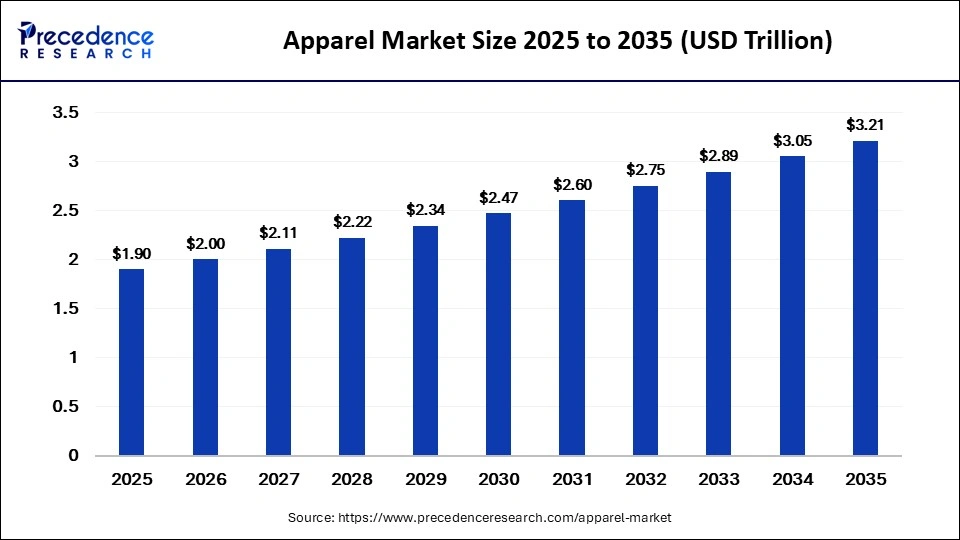
The growth is strongly driven by rising disposable incomes, expanding e-commerce platforms, changing fashion preferences, and the increasing influence of social media on consumer buying behavior.
Read Also: U.S. Environmental Remediation Market
Key Highlights of the Apparel Market
- Market size (2025): USD 1.90 Trillion
- Market size (2026): USD 2.00 Trillion
- Forecast value (2035): USD 3.21 Trillion
- CAGR (2026–2035): 5.40%
- Fastest-growing region: Asia-Pacific
- Leading segment: Women’s apparel
- Key channel: Offline retail still dominant, but online rapidly growing
Apparel Market Growth Drivers
1. Rising E-commerce and Digital Fashion Platforms
The rapid expansion of online retail platforms has transformed how consumers shop for apparel. Digital-first brands are using data-driven strategies, personalization, and influencer marketing to attract younger consumers.
2. Increasing Disposable Income
Growing income levels, especially in emerging economies like India and China, are boosting demand for fashion and lifestyle products.
3. Fast Fashion and Trend Cycles
Fast fashion brands are continuously introducing new collections, shortening product lifecycles and increasing consumption rates.
4. Social Media Influence
Platforms like Instagram, TikTok, and YouTube play a major role in shaping fashion trends and consumer purchase decisions.
5. Demand for Sustainable Fashion
Consumers are increasingly preferring eco-friendly clothing, recycled materials, and ethical manufacturing practices.
Market Restraints
- Environmental concerns due to textile waste
- Rising raw material costs
- Supply chain disruptions
- Increasing competition among fast fashion brands
- Regulatory pressure on sustainability practices
Apparel Market Segmentation
By Product Type
- Men’s apparel
- Women’s apparel
- Children’s apparel
👉 Women’s apparel holds the largest market share due to higher fashion diversity and frequent purchases.
By Material
- Cotton
- Synthetic fabrics
- Wool
- Leather
- Others
👉 Cotton remains the most widely used material globally.
By Sales Channel
- Offline retail stores
- Online e-commerce platforms
👉 Offline dominates currently, but online is growing the fastest.
By End Use
- Fashion wear
- Sports & activewear
- Casual wear
- Formal wear
👉 Sports and activewear is the fastest-growing category.
Regional Analysis
Asia-Pacific
Asia-Pacific dominates the global apparel market due to:
- Large population base
- Strong manufacturing ecosystem
- Rising middle-class income
- Expanding online retail penetration
North America
North America remains a major market driven by premium fashion brands and high consumer spending.
Europe
Europe is a key hub for luxury fashion brands and sustainable apparel innovation.
Latin America & Middle East & Africa
These regions are witnessing steady growth due to urbanization and increasing retail expansion.
Key Trends in the Apparel Market
1. Rise of Sustainable Fashion
Brands are adopting eco-friendly fabrics, recycling programs, and circular fashion models.
2. Growth of Athleisure
Comfort-driven clothing such as activewear and athleisure is becoming mainstream.
3. Digital-First Fashion Brands
Direct-to-consumer (DTC) brands are reshaping traditional retail structures.
4. AI in Fashion Industry
Artificial intelligence is improving demand forecasting, design automation, and personalized recommendations.
5. Second-Hand & Resale Market Growth
Resale fashion is gaining traction as consumers shift toward affordable and sustainable shopping options.
Competitive Landscape
The global apparel market is highly competitive with major players including:
- Nike Inc.
- Adidas AG
- H&M Group
- Inditex (Zara)
- LVMH
- Puma SE
- Burberry Group
- PVH Corp.
These companies are focusing on:
- Sustainability initiatives
- Digital transformation
- Direct-to-consumer sales
- Product innovation
Future Outlook (2026–2035)
The apparel industry is expected to undergo significant transformation over the next decade. Key future trends include:
- Expansion of AI-powered fashion design
- Growth of virtual try-on and digital clothing
- Strong shift toward circular economy models
- Increased dominance of online retail channels
- Rising demand for personalized fashion experiences
Conclusion
The global apparel market is entering a new era driven by digital transformation, sustainability, and evolving consumer preferences. With strong growth expected through 2035, the industry presents major opportunities for brands that adapt to fast-changing trends and invest in innovation.
Get Sample Link: https://www.precedenceresearch.com/sample/8413
For inquiries regarding discounts, bulk purchases, or customization requests, please contact us at sales@precedenceresearch.com