
Eyewear Market Size to Hit USD 297.53 Billion by 2035
The global eyewear market is a rapidly evolving industry that includes products such as spectacles, sunglasses, contact lenses, and smart glasses used for vision correction, protection, and fashion.
In 2025, the global eyewear market size was valued at approximately USD 160.00 billion. It is projected to reach around USD 170.24 billion in 2026 and further expand to nearly USD 297.53 billion by 2035, growing at a CAGR of 6.40% from 2026 to 2035.
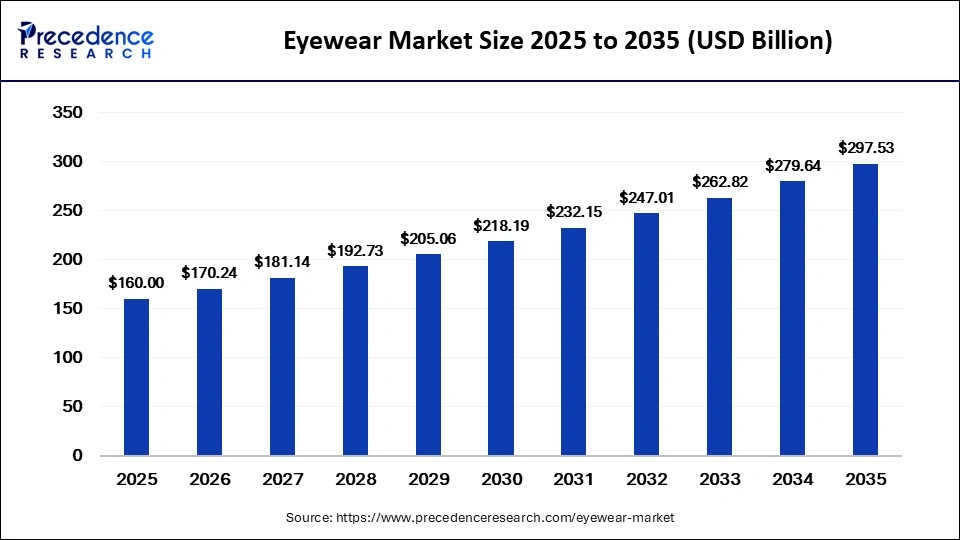
The market is being transformed by rising vision disorders, increasing screen time, fashion-oriented eyewear demand, and rapid technological innovation such as AI-powered smart glasses and virtual try-on solutions.
Read Also: Apparel Market
Key Highlights of the Eyewear Market
- Market size (2025): USD 160.00 Billion
- Market size (2026): USD 170.24 Billion
- Forecast value (2035): USD 297.53 Billion
- CAGR (2026–2035): 6.40%
- Dominant region: North America
- Fastest-growing region: Asia-Pacific
- Leading product: Prescription eyewear (spectacles)
- Fastest-growing segment: Sunglasses & smart eyewear
Eyewear Market Growth Drivers
1. Rising Vision Disorders Globally
Increasing cases of myopia, hyperopia, and other vision-related issues due to aging populations and prolonged screen exposure are significantly boosting demand for prescription eyewear.
2. Growing Fashion & Lifestyle Influence
Eyewear has evolved beyond medical use into a fashion statement, with premium frames, designer sunglasses, and branded collections driving market growth.
3. Expansion of E-commerce & Online Retail
Online platforms and virtual try-on technologies are making eyewear purchasing more accessible, convenient, and personalized.
4. Technological Advancements in Lens & Frames
Innovations such as anti-reflective coatings, lightweight materials, and blue-light protection lenses are improving product appeal.
5. Rise of AI and Smart Glasses
AI-powered eyewear is emerging as a new category, offering features like real-time translation, navigation, and object recognition.
Market Restraints
- High cost of premium eyewear and smart glasses
- Limited access to eye care in rural regions
- Product counterfeiting issues in fashion eyewear
- Regulatory requirements for medical-grade lenses
- Price sensitivity in developing economies
Eyewear Market Segmentation
By Product Type
- Prescription Eyewear (Spectacles)
- Sunglasses
- Contact Lenses
- Sports Eyewear
👉 Spectacles dominate the market due to high global vision correction needs.
By Distribution Channel
- Offline Retail (Optical stores, retail chains)
- Online/E-commerce platforms
👉 Offline channels currently dominate, but online eyewear sales are growing rapidly.
By Lens Type
- Single Vision Lenses
- Bifocal Lenses
- Progressive Lenses
- Photochromic Lenses
- Anti-reflective Lenses
By End Use
- Adults
- Children
👉 Adults account for the largest share due to higher incidence of vision disorders.
Regional Analysis
North America
North America leads the global eyewear market due to:
- High adoption of premium eyewear brands
- Strong healthcare infrastructure
- High awareness of vision correction
- Rapid adoption of smart glasses technologies
Europe
Europe remains a key market driven by:
- Strong luxury fashion eyewear industry
- Presence of leading manufacturers
- High consumer preference for designer frames
Asia-Pacific
Asia-Pacific is the fastest-growing region, supported by:
- Large population base
- Increasing screen time and vision issues
- Rising disposable income
- Expanding retail and e-commerce penetration
Latin America & Middle East & Africa
These regions are witnessing steady growth due to improving healthcare access and rising fashion adoption.
Key Trends in the Eyewear Market
1. Growth of Smart Eyewear
AI-enabled glasses are transforming eyewear into wearable computing devices.
2. Virtual Try-On Technology
AR-based solutions are helping consumers try frames online before purchasing.
3. Fashion-Driven Eyewear Demand
Eyewear is increasingly seen as a lifestyle accessory rather than just medical equipment.
4. Sustainable Eyewear Materials
Brands are adopting recycled plastics, biodegradable frames, and eco-friendly production.
5. Rise of Direct-to-Consumer Brands
Digital-first eyewear brands are disrupting traditional optical retail models.
Competitive Landscape
The global eyewear market is highly consolidated, with major players including:
- EssilorLuxottica
- Johnson & Johnson Vision
- Alcon Inc.
- Hoya Corporation
- Carl Zeiss AG
- Safilo Group
- Fielmann Group
- Marchon Eyewear
These companies focus on:
- Smart eyewear innovation
- Luxury brand expansion
- Digital transformation
- Strategic acquisitions
- Lens technology advancements
Future Outlook (2026–2035)
The eyewear market is expected to undergo a major transformation over the next decade:
- Expansion of AI-powered smart glasses ecosystem
- Strong growth in AR/VR integrated eyewear
- Increased demand for personalized and customized frames
- Wider adoption of online eye testing and virtual fitting
- Shift toward eyewear as a tech + fashion hybrid product
Conclusion
The global eyewear market is entering a new growth phase driven by innovation, digital transformation, and lifestyle shifts. From traditional spectacles to AI-powered smart glasses, the industry is evolving rapidly, offering strong opportunities for manufacturers, tech companies, and fashion brands through 2035.
Get a Sample Copy: https://www.precedenceresearch.com/sample/8415
For inquiries regarding discounts, bulk purchases, or customization requests, please contact us at sales@precedenceresearch.com