

The global non-invasive prenatal testing market is witnessing remarkable growth as precision medicine, artificial intelligence (AI), and next-generation sequencing (NGS) continue to transform prenatal care. The market size is calculated at USD 7.18 billion in 2025 and is projected to increase from USD 8.05 billion in 2026 to approximately USD 20.89 billion by 2035, expanding at a CAGR of 11.27% from 2026 to 2035.
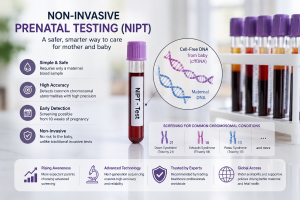

Growing maternal age, increasing awareness of genetic disorders, rising demand for safer prenatal screening, and continuous advancements in genomic technologies are accelerating the adoption of NIPT worldwide. Unlike traditional invasive diagnostic procedures such as amniocentesis and chorionic villus sampling (CVS), NIPT analyzes cell-free fetal DNA (cfDNA) from a maternal blood sample, offering highly accurate screening with minimal risk to both mother and fetus.
Today, the integration of AI, machine learning, cloud computing, and bioinformatics is reshaping prenatal genetic testing by enabling faster genomic analysis, improved diagnostic accuracy, predictive risk assessment, and personalized clinical decision-making.
Non-Invasive Prenatal Testing Market Overview
Non-invasive prenatal testing (NIPT) is an advanced genetic screening method that analyzes cell-free fetal DNA (cfDNA) circulating in maternal blood to identify chromosomal abnormalities without risking the pregnancy. Unlike invasive diagnostic procedures, NIPT requires only a maternal blood sample, making it one of the safest prenatal screening methods available. The technology is widely used to screen for conditions including Down syndrome (Trisomy 21), Edwards syndrome (Trisomy 18), Patau syndrome (Trisomy 13), Turner syndrome, and several other chromosomal abnormalities.
Growing awareness among expectant parents, improvements in sequencing technologies, declining testing costs, and stronger physician recommendations are making NIPT an increasingly important component of modern prenatal care worldwide. Continuous innovation in artificial intelligence, bioinformatics, machine learning, and genomic data interpretation is further improving test accuracy while reducing turnaround times and false-positive rates.
What is Non-Invasive Prenatal Testing?
Non-invasive prenatal testing (NIPT) is an advanced prenatal screening method used to detect fetal chromosomal abnormalities by analyzing fragments of fetal DNA circulating in the mother’s bloodstream. Because the test requires only a maternal blood sample, it eliminates many of the risks associated with invasive diagnostic procedures.
NIPT has become one of the most significant innovations in prenatal medicine due to its exceptional accuracy in screening for chromosomal conditions including:
- Down Syndrome (Trisomy 21)
- Edwards Syndrome (Trisomy 18)
- Patau Syndrome (Trisomy 13)
- Turner Syndrome
- Other chromosomal abnormalities
Healthcare providers increasingly recommend NIPT for women with high-risk pregnancies, advanced maternal age, abnormal ultrasound findings, or family histories of genetic disorders. Growing awareness among expectant parents and physicians has made NIPT one of the fastest-growing segments of molecular diagnostics.
Download the Sample: https://www.precedenceresearch.com/sample/3362
How Artificial Intelligence is Transforming the Non-Invasive Prenatal Testing Market
- Artificial intelligence is revolutionizing prenatal genetic screening by making NIPT faster, more accurate, and increasingly personalized.
- Traditional genomic analysis requires enormous computational resources to process sequencing data and identify chromosomal abnormalities. AI dramatically accelerates this process by analyzing millions of genomic data points within minutes while improving diagnostic precision.
- Machine learning algorithms continuously learn from expanding genomic databases, enabling laboratories to detect subtle chromosomal variations with greater confidence while reducing false-positive and false-negative results.
- AI also supports physicians by generating risk scores, interpreting complex sequencing data, and assisting genetic counselors in communicating personalized prenatal insights to expectant families.
- As healthcare systems increasingly adopt precision medicine, AI has become one of the strongest competitive differentiators in the global NIPT market.
AI Use Cases in the Non-Invasive Prenatal Testing Market
AI-Based Genomic Data Analysis
- One of the most important applications of AI is analyzing massive volumes of sequencing data generated during NIPT.
- Instead of manually interpreting millions of DNA fragments, machine learning algorithms rapidly identify chromosomal abnormalities by comparing fetal DNA patterns with validated genomic reference databases.
- This significantly improves testing speed while increasing diagnostic accuracy.
Intelligent Risk Prediction
- AI algorithms combine genomic findings with maternal age, medical history, ultrasound results, pregnancy characteristics, and clinical biomarkers to calculate individualized fetal risk profiles.
- Rather than providing only positive or negative screening results, AI delivers more comprehensive risk assessments that help physicians determine whether additional diagnostic procedures are necessary.
Automated Bioinformatics Workflows
Modern NIPT laboratories increasingly use AI-powered automation throughout sequencing workflows.
Artificial intelligence assists with:
- Sample quality assessment
- DNA sequencing optimization
- Variant identification
- Data validation
- Report generation
- Laboratory workflow management
Automation reduces human error while increasing laboratory efficiency and throughput.
Clinical Decision Support Systems
- Artificial intelligence provides physicians with evidence-based recommendations throughout prenatal care.
- Clinical decision support platforms analyze genetic findings alongside patient-specific information to assist obstetricians, maternal-fetal medicine specialists, and genetic counselors in making informed clinical decisions.
- This leads to more personalized pregnancy management.
AI-Enhanced Genetic Counseling
- Genetic counseling plays a critical role in prenatal screening.
- AI-powered platforms help counselors explain genetic risks using interactive visualizations, predictive analytics, and patient-friendly reports.
- These tools improve communication while helping families better understand complex genetic information before making important healthcare decisions.
Population-Level Genomic Research
AI is enabling researchers to analyze genomic datasets collected from millions of pregnancies worldwide.
This large-scale analysis helps identify:
- Rare genetic mutations
- Population-specific genetic risks
- New disease biomarkers
- Emerging prenatal screening opportunities
The insights generated through AI continue expanding the clinical capabilities of NIPT.
Supporting the Global Demand for Early Prenatal Screening
- Several long-term healthcare trends continue supporting the expansion of the NIPT market.
- Growing maternal age has significantly increased the incidence of chromosomal abnormalities, creating stronger demand for early prenatal screening.
- At the same time, increasing awareness regarding inherited genetic disorders encourages more expectant parents to undergo prenatal genetic testing.
- Healthcare providers also prefer NIPT because it reduces dependence on invasive diagnostic procedures that carry miscarriage risks.
- Government investments in maternal healthcare, expanding insurance reimbursement, improved prenatal care guidelines, and wider availability of advanced molecular diagnostics continue accelerating market adoption across developed and emerging economies.
Major Trends Influencing the Non-Invasive Prenatal Testing Market
Expansion of Early Prenatal Screening Programs
- Healthcare providers increasingly recommend NIPT during the first trimester due to its ability to detect chromosomal abnormalities early in pregnancy with exceptional accuracy.
- Earlier diagnosis enables better pregnancy planning, informed decision-making, and improved maternal care.
Advances in Next-Generation Sequencing
- Continuous improvements in sequencing technologies have increased the sensitivity, specificity, and affordability of NIPT.
- Modern NGS platforms generate faster results while detecting a broader range of chromosomal abnormalities than previous testing methods.
Growing Adoption in Emerging Markets
- Asia Pacific, Latin America, and parts of the Middle East are experiencing rapid adoption of NIPT due to improving healthcare infrastructure, increasing disposable income, expanding private healthcare services, and greater awareness of prenatal health.
- These regions are expected to create significant long-term growth opportunities.
Declining Testing Costs
- Technological innovation, laboratory automation, and economies of scale continue reducing the overall cost of NIPT.
- Improved affordability, combined with expanding reimbursement policies, is making prenatal genetic screening accessible to larger patient populations worldwide.
Industry Adoption of AI
Diagnostic Laboratories
- Leading molecular diagnostic laboratories are integrating AI throughout sequencing workflows to improve accuracy, automate quality control, reduce turnaround times, and manage growing testing volumes.
Biotechnology Companies
- Major biotechnology firms continue investing heavily in AI-driven genomic analysis, cloud-based bioinformatics platforms, and advanced prenatal screening technologies to strengthen their competitive positions.
Hospitals and Prenatal Care Centers
- Hospitals increasingly utilize AI-powered clinical decision support systems that integrate NIPT results with ultrasound findings and patient history to deliver more personalized prenatal care.
Research Institutions
- Academic researchers use AI to discover novel biomarkers, improve genomic interpretation, and expand NIPT applications beyond common chromosomal disorders toward single-gene disorders and rare inherited diseases.
Read More: Water Purifier Market
The Future Impact of Artificial Intelligence on the NIPT Market
- Artificial intelligence is expected to become one of the defining technologies shaping prenatal medicine over the next decade.
- Future AI platforms will integrate genomic sequencing, electronic health records, ultrasound imaging, maternal biomarkers, and clinical history into comprehensive predictive models capable of identifying pregnancy risks with unprecedented accuracy.
- As genomic databases continue expanding globally, machine learning algorithms will become increasingly sophisticated, enabling earlier disease detection, more precise genetic interpretation, and personalized prenatal care pathways.
- Cloud computing, AI-powered automation, and real-time genomic analytics will further reduce testing turnaround times while improving healthcare accessibility across both developed and emerging markets.
Looking Ahead
The global non-invasive prenatal testing market is evolving into a highly advanced precision diagnostics ecosystem driven by artificial intelligence, next-generation sequencing, bioinformatics, and personalized medicine. Growing maternal age, increasing awareness of genetic disorders, expanding prenatal screening programs, and continuous technological innovation will continue supporting long-term market growth.
North America currently maintains market leadership due to advanced healthcare infrastructure, widespread clinical adoption, and strong biotechnology innovation. Meanwhile, Asia Pacific is expected to witness the fastest growth, supported by expanding healthcare access, rising investments in genomic medicine, and increasing awareness of maternal health. As AI continues transforming genomic diagnostics, NIPT is expected to become even more accurate, accessible, and clinically valuable, strengthening its role as one of the most important prenatal screening technologies worldwide.
For report inquiries and custom research requirements, please contact our analyst team at
📧 sales@precedenceresearch.com