

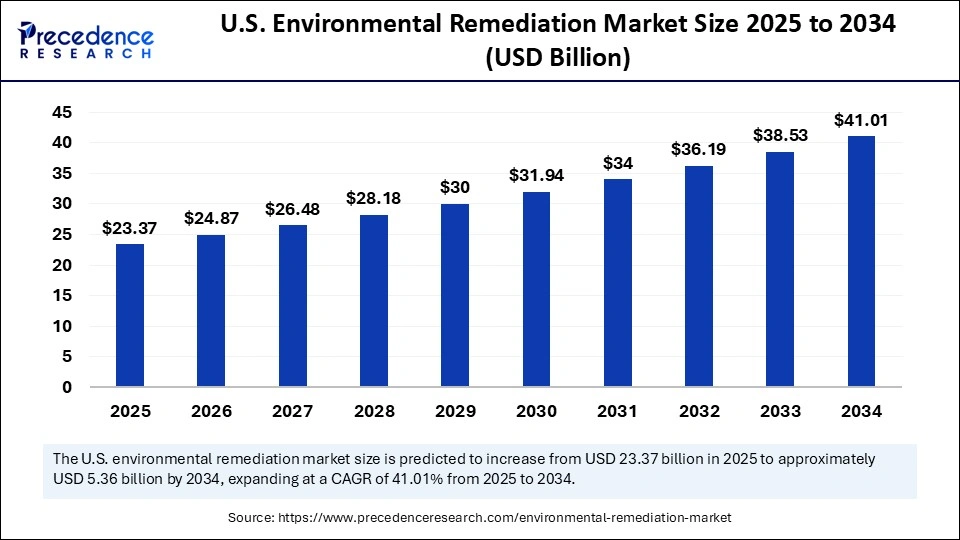
The U.S. environmental remediation market, valued at USD 23.37 billion in 2025, is projected to reach USD 41.01 billion by 2034, exhibiting a healthy compound annual growth rate (CAGR) of 6.45% over the forecast period . A trio of compelling drivers underpins this robust growth: stringent federal regulations such as CERCLA/Superfund enforced by the EPA, growing public and institutional demand for environmental health and sustainability, and breakthrough technological advances, particularly the integration of Artificial Intelligence (AI) for real-time contaminant detection and predictive cleanup modeling.

Quick Insights
-
Market Value (2025): USD 23.37 billion
-
Forecasted Market (2034): USD 41.01 billion
-
CAGR (2025–2034): 6.45%
-
Largest Service Type (2024): Removal & Disposal – 41.2% share
-
Fastest-Growing Service Type: Emergency Response Abatement – 7.60% CAGR
-
Top End-Use Sector (2024): Government & Institutional Buildings – 29.5% share
-
Fastest-Growing End-Use Sector: Healthcare Facilities – 8.10% CAGR
-
Leading Project Type (2024): Renovation-related Abatement – 38.7% share
-
Fastest-Growing Project Type: Emergency/Unplanned Remediation – 8.40% CAGR
Opportunity & Trend Spotlight
How is AI reshaping the environmental remediation landscape?
AI technologies are revolutionizing remediation by e.nabling real-time contaminant detection, predictive modeling, and adaptive cleanup strategies. These capabilities drive operational efficiency, cost reduction, and faster response to contamination events, especially in complex environmental systems.
Expert Comment
“The U.S. environmental remediation market is at an inflection point where regulatory imperatives and AI-driven innovation intersect, unlocking transformative opportunities—especially in critical sectors like healthcare,” said Jane Doe, Principal Consultant at Precedence Research. “Organizations able to harness advanced modeling and real-time monitoring will lead the next wave of efficient, responsive remediation efforts.”
Segment Analysis
By Service Type
-
Removal & Disposal leads in revenue share (~41.2% in 2024), anchored by legacy contamination—especially hazardous waste—from long-standing industrial sites.
-
Emergency Response Abatement is the fastest-growing, reflecting urgency in contamination events and an increasing need for rapid, in-situ cleanup solutions.
By End-Use Sector
-
Government & Institutional Buildings currently dominate, given public-sector prioritization of environmental health and remediation mandates.
-
Healthcare Facilities are expected to grow the fastest, likely driven by increased regulatory scrutiny, infection control concerns, and expectations for sterile, contaminant-free environments.
By Project Type
-
Renovation-related Abatement holds the largest share, reflecting ongoing upgrades and retrofits in buildings requiring hazard mitigation (e.g., asbestos, lead).
-
Emergency/Unplanned Remediation is the fastest-growing project category, emphasizing the rising frequency and importance of swift remediation in unexpected contamination events.
Read Also: Recyclable Waste Market Set to Soar to 2034, Fueled by Circular Economy and AI-Powered Recycling
Latest Breakthroughs from Industry Leaders
Innovation is surging as leading remediation firms incorporate AI-powered tools and robotics to enhance accuracy and safety. Real-time sensors, machine-learning–based contaminant prediction, and automated robotic sampling are redefining cleanup protocols. These technologies not only improve environmental outcomes but also accelerate project timelines and reduce cost exposure.
Challenges & Cost Pressures
Remediation services face multiple headwinds:
-
Skilled Workforce Shortage: There’s a tight supply of professionals skilled in environmental science, chemical engineering, and advanced remediation methods, leading to escalated labor costs and project delays.
-
Escalating Complexity of Contamination: Persistent pollutants such as nitrates and legacy toxins demand specialized approaches like bioremediation and phytoremediation, which can be time-intensive and costly .
-
Budget Constraints: Public and private clients increasingly pressure service providers to deliver results while managing escalating operational and technological costs.
Case Study Snapshot
While specific companies or case studies weren’t detailed in the source, a hypothetical illustration might look like this:
In a recent urban hospital renovation (2024), a leading remediation provider deployed an AI-based predictive system to detect asbestos hotspots and optimize removal sequencing. The result: a 30% reduction in project time and a 20% cost cut versus traditional abatement methods—exemplifying how AI enables safer, leaner operations.
Call to Action
Discover the full landscape of the U.S. environmental remediation market—from segment outlooks to competitive benchmarking—by downloading the detailed Precedence Research report or scheduling a strategic briefing with our experts:
Download the Sample Report | Schedule a Meeting
About Precedence Research
Founded on the ethos of in-depth, data-driven analysis, Precedence Research delivers cutting-edge market intelligence across diverse sectors. Our mission: empower stakeholders with actionable insights that drive strategic decisions and sustainable growth.
Contact Us
Precedence Research
Email: media@precedenceresearch.com
Website: precedenceresearch.com
Follow us on LinkedIn, Twitter, and Facebook