
U.S. Off-Road Vehicles Market Size, Trends & AI Insights
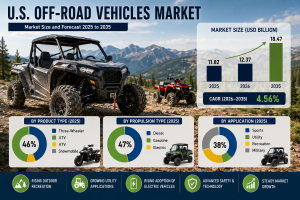
The U.S. off-road vehicles market is experiencing steady growth as outdoor recreation, agriculture, construction, defense, and utility industries continue to increase demand for high-performance all-terrain vehicles. The market size was USD 11.82 billion in 2025 and is projected to grow from USD 12.37 billion in 2026 to approximately USD 18.47 billion by 2035, expanding at a CAGR of 4.56% from 2026 to 2035.
The rising popularity of adventure tourism, recreational trail riding, farming operations, hunting, and commercial utility applications is driving the adoption of all-terrain vehicles (ATVs), utility task vehicles (UTVs), side-by-side vehicles, and off-road trucks across the United States. In addition, technological advancements such as AI-powered navigation, connected vehicle systems, GPS tracking, electric propulsion, and advanced suspension technologies are transforming the off-road driving experience.
Today, manufacturers are increasingly integrating artificial intelligence (AI), Internet of Things (IoT), cloud connectivity, autonomous driving assistance, predictive maintenance, and electric mobility technologies into off-road vehicles to improve safety, efficiency, durability, and user experience.
U.S. Off-Road Vehicles Market Overview
The U.S. off-road vehicles market consists of vehicles specifically engineered to operate on rugged landscapes such as mountains, forests, deserts, muddy trails, sand dunes, rocky paths, and other unpaved environments. Unlike conventional passenger vehicles, off-road vehicles feature specialized suspension systems, higher ground clearance, durable chassis, and advanced traction technologies that enable superior performance under extreme driving conditions.
The market includes a diverse range of vehicle categories, including all-terrain vehicles (ATVs), utility terrain vehicles (UTVs), side-by-side vehicles, three-wheelers, snowmobiles, and specialized off-road trucks. These vehicles are widely utilized across recreational, agricultural, forestry, mining, military, emergency response, and construction applications. As outdoor recreation continues to gain popularity across the United States, off-road vehicle ownership is steadily increasing among adventure enthusiasts. Simultaneously, commercial industries are adopting off-road vehicles to improve productivity in remote and difficult-to-access work environments.
Rapid advancements in battery technology, AI-enabled vehicle systems, smart navigation, and connected mobility solutions are further transforming the market, enabling manufacturers to introduce safer, smarter, and more sustainable off-road vehicles.
Download the Sample: https://www.precedenceresearch.com/sample/4099
What are Off-Road Vehicles?
Off-road vehicles (ORVs) are specially engineered motor vehicles designed to operate on rough, uneven, and unpaved terrains where conventional road vehicles cannot perform efficiently. These vehicles are built with rugged construction, high ground clearance, durable suspension systems, specialized tires, and powerful engines that enable them to navigate challenging environments such as dirt trails, rocky landscapes, sand dunes, forests, mud, and mountainous regions.
Off-road vehicles serve a wide range of purposes beyond recreation. They are extensively used in agriculture, construction, forestry, mining, military operations, emergency response, and utility services due to their versatility, durability, and ability to access remote locations. Common types of off-road vehicles include All-Terrain Vehicles (ATVs), Utility Task Vehicles (UTVs), side-by-side vehicles, dirt bikes, snowmobiles, off-road trucks, and three-wheelers. Modern off-road vehicles increasingly feature advanced technologies such as GPS navigation, smart connectivity, AI-assisted terrain management, and electric powertrains, enhancing both performance and safety while supporting sustainable mobility trends.
How Artificial Intelligence is Transforming the U.S. Off-Road Vehicles Market
- Artificial intelligence is becoming a key technology driving innovation across the off-road vehicle industry. Manufacturers are increasingly integrating AI-powered systems to improve vehicle safety, optimize performance, enhance navigation, and deliver predictive maintenance capabilities.
- Traditional off-road driving often depends heavily on driver experience and manual decision-making while navigating unpredictable terrain. AI significantly enhances this process by continuously analyzing data from cameras, sensors, GPS systems, accelerometers, and onboard diagnostics to help vehicles respond intelligently to changing driving conditions.
- Machine learning algorithms can evaluate terrain characteristics, optimize power delivery, recommend ideal driving modes, and monitor vehicle performance in real time. These intelligent systems reduce mechanical wear, improve fuel efficiency, and provide a safer driving experience across challenging environments.
- As connected vehicles become increasingly common, AI is also supporting cloud-based fleet management, autonomous vehicle technologies, battery optimization for electric off-road vehicles, and advanced driver assistance systems (ADAS), positioning artificial intelligence as one of the most important technological trends shaping the future of the U.S. off-road vehicles market.
AI Use Cases in the U.S. Off-Road Vehicles Market
AI-Based Terrain Recognition
- One of the most significant applications of AI in off-road vehicles is terrain recognition.
- Artificial intelligence continuously analyzes data collected from onboard cameras, radar, GPS, wheel sensors, and suspension systems to identify terrain conditions such as mud, gravel, sand, snow, rocks, and steep inclines. Based on these real-time assessments, the vehicle automatically adjusts traction control, suspension settings, torque distribution, and stability systems to maximize performance and driver safety.
- This technology enables drivers to navigate difficult environments with greater confidence while reducing the likelihood of vehicle damage or loss of control.
Predictive Maintenance
- Artificial intelligence is helping manufacturers minimize unexpected equipment failures through predictive maintenance.
- AI algorithms monitor engine temperature, oil pressure, transmission health, battery condition, tire wear, suspension performance, and numerous other vehicle parameters. By identifying early warning signs of component degradation, AI alerts operators before failures occur, allowing preventive maintenance to be scheduled efficiently.
- This approach reduces downtime, lowers maintenance costs, extends vehicle lifespan, and improves fleet reliability for commercial operators in industries such as agriculture, mining, forestry, and construction.
Smart Navigation and Route Optimization
- Modern off-road vehicles increasingly utilize AI-powered navigation systems capable of providing intelligent route guidance across remote and unstructured environments.
- Unlike conventional GPS navigation, AI considers terrain difficulty, weather conditions, elevation changes, fuel availability, and historical trail data when recommending routes. These intelligent navigation platforms help recreational users discover safer trails while enabling commercial operators to optimize travel efficiency across large worksites.
- Real-time hazard detection and route updates further enhance operational safety during outdoor adventures and industrial activities.
Connected Fleet Management
- Commercial fleet operators are adopting AI-powered fleet management systems to improve operational efficiency.
- These intelligent platforms provide real-time visibility into vehicle location, fuel consumption, driver behavior, maintenance schedules, equipment utilization, and operating costs. Fleet managers can analyze performance across multiple vehicles simultaneously, enabling data-driven decisions that improve productivity while reducing operating expenses.
- Such capabilities are particularly valuable for agriculture, mining, forestry, public utilities, and infrastructure development projects where off-road vehicles operate across large geographic areas.
Advanced Driver Assistance Systems (ADAS)
Artificial intelligence is also supporting the adoption of advanced driver assistance technologies in premium off-road vehicles.
These systems include:
- Hill descent control
- Automatic emergency braking
- Obstacle detection
- Adaptive traction control
- Roll stability management
- Intelligent braking assistance
By assisting drivers during challenging off-road conditions, AI improves safety while making off-road driving more accessible to less experienced users.
Electric Off-Road Vehicle Optimization
- The growing adoption of electric ATVs and UTVs has created new opportunities for AI-powered battery management.
- Artificial intelligence optimizes charging cycles, predicts battery degradation, monitors energy consumption, and adjusts power output according to terrain conditions. This improves driving range, extends battery lifespan, and enhances the overall performance of electric off-road vehicles.
- As battery technology continues to advance, AI will play an increasingly important role in supporting the widespread commercialization of electric off-road mobility.
Supporting the Growing Demand for Outdoor Recreation and Utility Vehicles
Several long-term economic and lifestyle trends continue to support the expansion of the U.S. off-road vehicles market. Outdoor recreation has become an integral part of American culture, with millions of consumers participating in activities such as trail riding, hunting, camping, rock crawling, overlanding, and adventure tourism. This growing enthusiasm for outdoor experiences is encouraging both first-time buyers and experienced enthusiasts to invest in high-performance off-road vehicles.
Beyond recreational use, off-road vehicles are increasingly recognized as essential equipment across industries including agriculture, forestry, construction, mining, oil & gas, and public utilities. Farmers and ranchers rely on UTVs and ATVs for transporting equipment, inspecting fields, managing livestock, and navigating rough terrain efficiently. Construction companies utilize these vehicles for moving personnel and materials across large worksites, while mining operators depend on rugged off-road vehicles to improve productivity in remote locations.
Government initiatives supporting outdoor recreation, trail development, public land access, and tourism continue to strengthen market demand. At the same time, growing investments in electric mobility, smart infrastructure, and sustainable transportation are encouraging manufacturers to develop cleaner and more technologically advanced off-road vehicles that meet evolving consumer expectations.
Major Trends Influencing the U.S. Off-Road Vehicles Market
Rising Demand for Utility Terrain Vehicles (UTVs)
- Utility Terrain Vehicles (UTVs) are becoming one of the fastest-growing categories within the U.S. off-road vehicles market. Their versatility, larger seating capacity, cargo-carrying capability, and superior towing performance make them highly suitable for agriculture, construction, forestry, defense, and recreational activities.
- Modern UTVs are equipped with advanced suspension systems, digital instrument clusters, intelligent traction management, and enhanced safety features, making them increasingly attractive for both commercial users and outdoor enthusiasts.
Growing Adoption of Electric Off-Road Vehicles
- Electrification is gradually transforming the off-road vehicle industry as manufacturers introduce battery-powered ATVs, UTVs, and side-by-side vehicles. Electric off-road vehicles offer several advantages, including reduced emissions, quieter operation, lower maintenance requirements, and instant torque delivery, making them well suited for recreational trails, farms, and environmentally sensitive areas.
- As battery technologies continue to improve and charging infrastructure expands, electric off-road vehicles are expected to become a larger contributor to future market growth.
Integration of Smart Connectivity
- Today’s consumers increasingly expect their vehicles to provide connected digital experiences. As a result, manufacturers are integrating smart technologies such as Bluetooth connectivity, smartphone applications, cloud diagnostics, GPS navigation, wireless software updates, and digital dashboards into off-road vehicles.
- These connected features improve convenience, enable remote vehicle monitoring, simplify maintenance scheduling, and enhance the overall ownership experience.
Advanced Suspension and Ride Comfort Technologies
- Manufacturers continue investing in advanced suspension systems capable of automatically adapting to changing terrain conditions. Electronically controlled suspension, intelligent shock absorbers, and adaptive damping systems provide improved ride comfort while maintaining vehicle stability across rocky trails, sand dunes, muddy roads, and mountainous terrain.
- These innovations improve driver confidence while expanding the range of environments where off-road vehicles can operate safely.
Expansion of Adventure Tourism
- Adventure tourism continues to create significant opportunities for the U.S. off-road vehicles market. Guided ATV tours, UTV rentals, off-road racing events, camping expeditions, and overlanding experiences are becoming increasingly popular among domestic and international travelers.
- Growing investments in recreational parks, trail networks, and tourism infrastructure continue encouraging vehicle purchases while creating new business opportunities for rental operators and tour companies.
Industry Adoption of Artificial Intelligence
- Automotive Manufacturers: Leading vehicle manufacturers are incorporating AI throughout product development and vehicle operations. Intelligent systems improve terrain response, optimize fuel efficiency, enhance navigation, and enable predictive maintenance capabilities that improve customer satisfaction and vehicle reliability.
- Agriculture: Farmers increasingly deploy AI-enabled utility vehicles for crop inspection, irrigation monitoring, livestock management, and transportation across large agricultural properties. Connected vehicles help improve productivity while reducing labor requirements.
- Construction and Mining: Construction firms and mining operators utilize AI-powered fleet management systems to monitor equipment utilization, schedule preventive maintenance, optimize fuel consumption, and improve operational efficiency across demanding work environments.
- Defense and Public Safety: Military organizations and emergency response agencies continue evaluating AI-enabled off-road vehicles capable of autonomous navigation, obstacle detection, route optimization, and mission support across difficult terrain. These technologies improve mobility while enhancing personnel safety during critical operations.
Market Dynamics
Driver: Expanding Commercial and Industrial Applications
- Commercial demand continues to be one of the strongest growth drivers for the U.S. off-road vehicles market. Industries such as agriculture, mining, forestry, construction, utilities, and oil & gas increasingly depend on rugged off-road vehicles to transport workers, equipment, and supplies across difficult environments.
- Their durability, versatility, and ability to access remote locations make them indispensable assets for improving operational efficiency. As infrastructure development and industrial activities expand nationwide, demand for specialized off-road vehicles is expected to remain strong throughout the forecast period.
Driver: Growing Interest in Outdoor Recreation
- The increasing popularity of outdoor recreation is significantly contributing to market expansion. Consumers are spending more on adventure travel, camping, hunting, motorsports, trail riding, and recreational tourism, driving demand for ATVs, UTVs, and side-by-side vehicles.
- Rising disposable incomes, expanding recreational infrastructure, and the availability of rental services are encouraging more consumers to experience off-road activities, supporting long-term market growth.
Restraint: Rising Manufacturing Costs
- One of the primary challenges facing the industry is the increasing cost of manufacturing advanced off-road vehicles. Modern safety systems, emission control technologies, premium suspension components, and connected electronics have significantly increased production costs.
- These higher manufacturing expenses are reflected in vehicle prices, which may reduce affordability for recreational buyers and limit adoption among price-sensitive consumers.
Opportunity: Digital Technologies and Connected Mobility
- Digital transformation presents one of the largest opportunities for manufacturers. Integration of artificial intelligence, GPS navigation, cloud connectivity, telematics, predictive diagnostics, and mobile applications is creating new value for consumers and commercial operators alike.
- Smart off-road vehicles capable of real-time monitoring, remote diagnostics, over-the-air software updates, and intelligent route planning are expected to become increasingly popular over the coming decade.
The Future Impact of Artificial Intelligence on the U.S. Off-Road Vehicles Market
Artificial intelligence is expected to become one of the defining technologies shaping the future of off-road mobility in the United States.
Future AI platforms will combine onboard sensors, satellite connectivity, digital mapping, weather forecasting, battery analytics, vehicle diagnostics, and cloud computing into fully connected intelligent mobility ecosystems. These technologies will enable vehicles to continuously adapt to changing terrain conditions while optimizing energy consumption, navigation, and overall performance.
Machine learning algorithms will improve autonomous driving capabilities for specialized commercial applications such as agriculture, mining, defense, forestry, and infrastructure inspection. AI-powered predictive maintenance will further reduce equipment downtime by identifying mechanical issues before failures occur, improving reliability and lowering operating costs.
As electric off-road vehicles become more common, AI-driven battery management systems will optimize charging cycles, monitor battery health, and maximize vehicle range. Combined with connected fleet management platforms and over-the-air software updates, these innovations will transform off-road vehicles into intelligent mobility solutions capable of delivering greater efficiency, safety, and sustainability.
Recent Developments in U.S. Off-Road Vehicles Market
Kandi Technologies Expands U.S. Manufacturing (2025)
- Kandi Technologies began production at its Texas manufacturing facility, rolling out its first U.S.-assembled electric golf cart. The investment strengthens domestic production capabilities while improving product availability and delivery efficiency across the U.S. market. The initiative also reflects the growing demand for locally manufactured electric off-road vehicles.
Kandi Technologies Receives Positive Market Outlook (2025)
- Argus Research initiated coverage of Kandi Technologies, highlighting the company’s strategic expansion into electric off-road vehicles, including golf carts and utility terrain vehicles. The firm’s growing retail partnerships and battery-swapping technology are expected to support long-term growth in North America’s off-road EV segment.
Toyota Introduces the Land Cruiser 250 Series (2024)
- Toyota announced the launch of the Land Cruiser 250 Series featuring a powerful turbocharged engine, advanced four-wheel-drive capabilities, and improved off-road technologies. The new model reinforces Toyota’s commitment to expanding its presence within the premium off-road vehicle segment.
Read More: U.S. Vehicle-to-Grid Technology Market
Leading Companies of U.S. Off-Road Vehicles Market
Some of the major companies operating in the U.S. off-road vehicles market include:
- Polaris Inc.
- Arctic Cat Inc.
- Yamaha Motor Corporation
- Honda Motor Co., Ltd.
- Kawasaki Motors Corp., U.S.A.
- Can-Am (BRP Inc.)
- Suzuki Motor Corporation
- John Deere
- Textron Inc.
- Kubota Corporation
- KYMCO
- CFMOTO
- Mahindra & Mahindra Limited
- Massimo Motor
- American Landmaster
These companies continue investing in product innovation, electrification, autonomous technologies, and digital connectivity to strengthen their market positions and address evolving customer requirements.
Looking Ahead
The U.S. off-road vehicles market is evolving beyond traditional recreational transportation into a technologically advanced mobility ecosystem driven by artificial intelligence, electrification, connected vehicle technologies, and smart fleet management. Growing demand from outdoor enthusiasts, farmers, construction companies, defense organizations, and industrial operators will continue supporting long-term market expansion.
While recreational applications remain the foundation of market demand, increasing adoption across agriculture, mining, forestry, public utilities, and military operations is creating new opportunities for manufacturers to diversify their product portfolios. Continuous improvements in battery technology, intelligent navigation systems, predictive maintenance, and autonomous driving assistance will further enhance vehicle capabilities and customer experience.
California currently leads the market due to its strong outdoor recreation culture and growing adoption of electric off-road vehicles, while Texas and Florida continue to emerge as high-growth regional markets supported by agriculture, tourism, industrial development, and expanding recreational infrastructure.
As manufacturers continue investing in AI-powered technologies, sustainable mobility solutions, and advanced off-road engineering, the U.S. off-road vehicles market is well positioned to deliver steady growth throughout the forecast period, offering significant opportunities for vehicle manufacturers, technology providers, fleet operators, and investors.
For report inquiries and custom research requirements, please contact our analyst team at