
U.S. Vehicle-to-Grid Technology Market Size, Trends & AI Insights
The U.S. vehicle-to-grid technology market is entering a phase of rapid expansion as electric vehicle (EV) adoption, smart grid modernization, artificial intelligence (AI), and renewable energy integration reshape the nation’s energy ecosystem. The market size is estimated at USD 1.85 billion in 2025 and is projected to increase from USD 2.45 billion in 2026 to approximately USD 30.84 billion by 2035, expanding at a CAGR of 32.49% from 2026 to 2035.
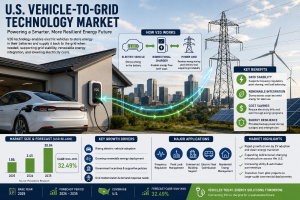
Growing deployment of electric vehicles, increasing renewable energy generation, supportive government policies, and investments in distributed energy resources are accelerating the adoption of vehicle-to-grid technology across the United States. Unlike conventional EV charging systems, V2G technology enables electric vehicles to both draw electricity from and return stored energy to the power grid, transforming EVs into mobile energy storage assets.
Today, the integration of artificial intelligence, machine learning, cloud computing, Internet of Things (IoT), and advanced energy management platforms is revolutionizing vehicle-grid integration by improving grid reliability, optimizing energy distribution, enhancing battery performance, and enabling real-time electricity trading.
U.S. Vehicle-to-Grid Technology Market Overview
Vehicle-to-grid (V2G) technology enables bidirectional power flow between electric vehicles and the electricity grid. Through specialized bidirectional charging systems, EV batteries can store excess electricity generated from renewable sources such as solar and wind energy and discharge that energy back to the grid during periods of peak demand.
As the U.S. accelerates its transition toward clean energy and transportation electrification, V2G has emerged as one of the most promising technologies for balancing electricity supply and demand while improving grid resilience.
Rapid advances in charging infrastructure, battery technology, AI-powered energy management, and cloud-based grid monitoring are making V2G increasingly viable for residential, commercial, utility, and fleet applications. Growing collaborations between utilities, automakers, charging infrastructure providers, and software companies are further strengthening the commercialization of V2G solutions across the country.
Download the Sample: https://www.precedenceresearch.com/sample/3738
What is Vehicle-to-Grid (V2G) Technology?
Vehicle-to-grid technology allows electric vehicles to communicate with the electrical grid through bidirectional chargers that both charge EV batteries and discharge stored electricity back into the grid whenever needed. Instead of functioning solely as transportation, electric vehicles become distributed energy storage resources capable of supporting electricity networks.
Major applications include:
- Peak load management
- Frequency regulation
- Renewable energy storage
- Emergency backup power
- Demand response programs
- Microgrid support
- Energy arbitrage
Utilities, commercial fleet operators, municipalities, and homeowners increasingly view V2G as an important solution for enhancing energy flexibility while reducing electricity costs and supporting decarbonization goals.
How Artificial Intelligence is Transforming the U.S. Vehicle-to-Grid Technology Market
Artificial intelligence is becoming the backbone of next-generation vehicle-grid integration.
Managing thousands or eventually millions of connected electric vehicles requires continuous analysis of battery conditions, electricity demand, renewable energy availability, pricing signals, and grid constraints. AI enables this level of coordination by processing vast volumes of real-time energy data far faster than traditional systems.
Machine learning algorithms continuously optimize charging schedules, predict electricity demand, balance renewable energy fluctuations, and determine the ideal times for vehicles to discharge stored electricity back into the grid. AI also helps utilities forecast consumption patterns, prevent grid congestion, and maximize renewable energy utilization.
As smart grids continue expanding across the United States, AI-powered V2G platforms are becoming a critical competitive advantage for utilities, automakers, charging operators, and energy service providers.
AI Use Cases in the U.S. Vehicle-to-Grid Technology Market
AI-Based Energy Forecasting
- Artificial intelligence analyzes historical electricity usage, weather conditions, renewable energy generation, traffic patterns, and EV charging behavior to accurately forecast grid demand.
- This allows utilities to optimize charging schedules and prevent overloads while maintaining stable electricity supply.
Intelligent Charging Optimization
- AI determines the most efficient charging and discharging schedules for each connected vehicle.
- Instead of charging immediately after plug-in, AI considers electricity prices, battery health, renewable energy availability, and expected driving schedules before making charging decisions.
- This reduces energy costs while maximizing battery efficiency.
Predictive Battery Health Management
- Battery degradation remains one of the major concerns in V2G deployment.
- AI continuously monitors battery temperature, charging cycles, voltage fluctuations, and usage patterns to predict battery aging and recommend optimal operating conditions.
- Predictive maintenance extends battery life while reducing ownership costs.
Smart Grid Load Balancing
- AI coordinates thousands of connected electric vehicles to automatically supply electricity during periods of peak demand and recharge during off-peak hours.
This significantly improves:
- Grid stability
- Peak demand management
- Renewable energy utilization
- Voltage regulation
- Grid resilience
Virtual Power Plant (VPP) Management
- Artificial intelligence enables thousands of electric vehicles to function collectively as a virtual power plant.
- AI platforms determine which vehicles should supply electricity based on battery availability, customer preferences, electricity demand, and market pricing.
- This creates flexible distributed energy networks capable of supporting large-scale grid operations.
Predictive Maintenance for Charging Infrastructure
- AI continuously monitors charging stations and bidirectional equipment for early signs of equipment failure.
- Machine learning detects anomalies before breakdowns occur, reducing maintenance costs while improving charging network reliability.
Supporting America’s Clean Energy Transition
- Several long-term energy trends continue accelerating the adoption of V2G technology across the United States.
- Rapid electric vehicle adoption has significantly expanded the nation’s distributed battery storage capacity. Simultaneously, increasing investments in renewable energy are creating greater demand for flexible storage solutions capable of balancing intermittent solar and wind generation.
- Federal investments under infrastructure modernization programs, utility-led smart grid initiatives, expanding charging infrastructure, and supportive state-level clean energy policies are strengthening the commercial viability of vehicle-to-grid systems.
- Growing corporate sustainability commitments and fleet electrification programs are also encouraging businesses to integrate V2G into their long-term energy strategies.
Major Trends Influencing the U.S. Vehicle-to-Grid Technology Market
Rapid Expansion of Bidirectional Charging Infrastructure
- Utilities, charging network operators, and automakers are significantly increasing investments in bidirectional charging stations capable of supporting two-way electricity flow between EVs and the power grid.
- The availability of advanced charging infrastructure is laying the foundation for widespread V2G commercialization.
Integration with Renewable Energy Systems
- Vehicle-to-grid technology is increasingly being paired with solar farms, wind energy projects, and residential rooftop solar installations.
- Electric vehicles serve as flexible energy storage units that absorb excess renewable generation and release electricity during periods of high demand.
Growth of Virtual Power Plants
- Utilities are deploying V2G-enabled EV fleets as virtual power plants capable of delivering grid services including frequency regulation, reserve capacity, and demand response.
- This decentralized approach enhances energy resilience while reducing reliance on fossil-fuel peaker plants.
Commercial Fleet Electrification
- School buses, delivery vehicles, municipal fleets, and commercial transportation operators are becoming early adopters of V2G technology due to predictable charging schedules and large battery capacities.
- Fleet-based V2G deployments are expected to generate significant revenue opportunities throughout the forecast period.
Industry Adoption of AI
- Utilities: Electric utilities increasingly deploy AI-powered energy management systems to optimize electricity distribution, coordinate V2G participation, and improve overall grid reliability.
- Automakers: Leading automotive manufacturers are integrating intelligent bidirectional charging capabilities into next-generation electric vehicles while collaborating with utilities to expand V2G ecosystems.
- Charging Infrastructure Providers: Charging companies utilize AI to optimize charger utilization, improve network efficiency, predict maintenance needs, and maximize energy trading opportunities.
- Research Institutions: Universities and energy research organizations continue leveraging AI to improve battery technologies, develop advanced grid optimization models, and expand commercial V2G applications.
Leading Companies in the U.S. Vehicle-to-Grid Technology Market
- ABB
- AC Propulsion, Inc.
- Edison International
- EV Grid, Inc.
- Fermata Energy
- Hitachi Ltd.
- Honda Motor Co., Ltd.
- NRG Energy, Inc.
- Nuvve Holding Corp.
- Wallbox Inc.
Recent Developments in U.S. Vehicle-to-Grid Technology Market
- March 2026: Xos announced plans to begin manufacturing electric vehicles equipped with vehicle-to-grid capability, initially targeting North American electric school buses.
- February 2026: Tesla introduced the Powershare Grid Support Program in Texas, enabling Cybertruck owners to export electricity back to the grid and receive energy bill credits.
- August 2025: Eaton and ChargePoint jointly launched the ChargePoint Express Grid, a high-power DC V2X charging solution supporting up to 600 kW for passenger EVs and megawatt-scale charging for heavy-duty fleets.
- January 2025: Nuvve Holding Corp. introduced a new portfolio of bidirectional and unidirectional charging systems ranging from 20 kW to 360 kW for fleet, infrastructure, and microgrid applications.
Read More: Non-Invasive Prenatal Testing Market
The Future Impact of Artificial Intelligence on the U.S. Vehicle-to-Grid Technology Market
Artificial intelligence is expected to become one of the most transformative technologies shaping the future of America’s smart grid.
Future AI platforms will integrate vehicle telematics, electricity market pricing, weather forecasts, renewable generation, battery analytics, and smart home energy systems into unified energy management ecosystems.
As millions of connected EVs enter the market, AI will autonomously coordinate charging schedules, optimize electricity trading, reduce grid congestion, and maximize renewable energy utilization across the country.
Cloud computing, edge analytics, digital twins, and autonomous energy management platforms will further improve grid resilience while enabling consumers to actively participate in energy markets through their electric vehicles.
Looking Ahead
The U.S. vehicle-to-grid technology market is rapidly evolving into a sophisticated smart energy ecosystem powered by artificial intelligence, connected electric vehicles, cloud computing, and advanced grid infrastructure. Rising EV adoption, accelerating renewable energy deployment, supportive government policies, and continued technological innovation are expected to sustain strong market growth over the next decade.
California currently leads the market through aggressive clean energy initiatives and extensive V2G pilot deployments, while states such as Texas and New York are rapidly expanding commercial adoption through grid modernization and transportation electrification programs. As AI continues optimizing energy management and bidirectional charging systems become more widely available, vehicle-to-grid technology is poised to become a foundational component of the future U.S. energy landscape.
For report inquiries and custom research requirements, please contact our analyst team at