

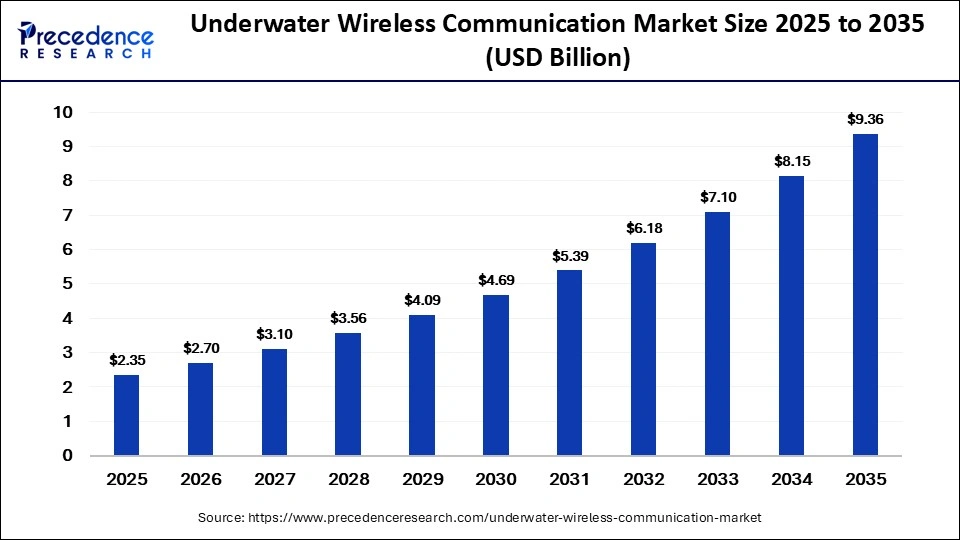
The global underwater wireless communication market is expected to grow from USD 2.70 billion in 2026 to USD 9.36 billion by 2035 at a CAGR of 14.8%, fueled by defense modernization, underwater sensor networks, offshore renewable energy, and marine research initiatives.

Read Also: Digital Infrastructure Market
Underwater Wireless Communication Market Set for Robust Growth as Smart Ocean Technologies Gain Momentum
Introduction
The increasing need for reliable underwater connectivity is transforming the maritime industry and driving substantial investments in underwater wireless communication technologies. From naval defense operations and offshore energy exploration to environmental monitoring and autonomous underwater vehicles (AUVs), underwater communication systems have become essential for enabling real-time data exchange in challenging aquatic environments.
As governments and private organizations accelerate their focus on maritime security, ocean research, and offshore infrastructure, underwater wireless communication technologies are emerging as critical enablers of the next generation of smart ocean ecosystems.
Market Overview
The global underwater wireless communication market size was valued at USD 2.35 billion in 2025 and is projected to grow from USD 2.70 billion in 2026 to approximately USD 9.36 billion by 2035, registering a strong CAGR of 14.80% during the forecast period.
The market growth is primarily driven by increasing deployment of underwater communication systems across defense applications, offshore oil & gas operations, marine research programs, underwater robotics, and environmental monitoring projects.
Understanding Underwater Wireless Communication
Underwater wireless communication refers to the transmission of data, voice, and sensor information through aquatic environments using technologies such as acoustic waves, optical signals, and radio frequency communication.
These communication systems support various applications, including:
- Marine environmental monitoring
- Underwater surveillance
- Offshore infrastructure inspection
- Seabed mapping
- Autonomous underwater vehicle operations
- Scientific ocean research
- Naval communication networks
The growing demand for real-time underwater connectivity is creating new opportunities for advanced communication technologies and intelligent underwater networks.
Impact of Artificial Intelligence on Underwater Communication
Artificial Intelligence (AI) is playing an increasingly important role in enhancing underwater communication systems. AI-powered solutions are improving:
- Signal processing efficiency
- Network optimization
- Autonomous navigation
- Energy management
- Semantic communication capabilities
- Marine wildlife monitoring
AI algorithms help underwater sensor networks operate more efficiently while reducing energy consumption and improving communication reliability in complex underwater environments.
Key Market Drivers
Growing Demand for Advanced Underwater Communication Systems
Increasing underwater exploration activities and offshore operations are driving demand for reliable communication infrastructure. Industries are adopting underwater communication systems to support autonomous vehicles, remote monitoring platforms, and underwater robotics.
Expansion of Defense and Maritime Security Programs
Defense organizations worldwide are investing heavily in underwater surveillance systems, anti-submarine warfare technologies, and secure communication networks. Rising geopolitical tensions and maritime security concerns continue to accelerate market growth.
Increasing Offshore Energy Exploration
The expansion of offshore oil & gas exploration activities and subsea infrastructure monitoring projects is creating significant demand for underwater communication solutions capable of supporting real-time monitoring and predictive maintenance.
Rising Ocean Research and Environmental Monitoring Initiatives
Governments and research institutions are deploying underwater sensor networks to monitor marine ecosystems, climate change impacts, and ocean health. These initiatives are contributing substantially to market expansion.
Emerging Market Trends
Integration of Swarm AUVs and Underwater IoT
The integration of Autonomous Underwater Vehicles (AUVs) with Internet of Underwater Things (IoUT) ecosystems is enabling enhanced underwater operations, better data collection, and improved mission coordination.
Adoption of Advanced Signal Processing Technologies
Modern underwater communication systems are increasingly utilizing advanced modulation techniques, adaptive beamforming, forward-error correction mechanisms, and sophisticated signal detection technologies to improve communication quality.
Growing Use of Electromagnetic Communication Systems
Military organizations are increasingly adopting electromagnetic communication technologies for secure submarine-to-command-center communication, supporting defense modernization initiatives worldwide.
Development of Smart Ocean Infrastructure
Smart ports, offshore renewable energy facilities, underwater sensor networks, and marine monitoring systems are creating demand for next-generation underwater communication technologies.
Segment Analysis
Acoustic Communication Dominates the Market
By technology, the acoustic communication segment accounted for 68% of market revenue in 2025.
Acoustic communication remains the preferred technology because of its ability to transmit signals over long underwater distances. The technology is widely used in defense systems, underwater monitoring networks, and oceanographic research.
Optical Communication Emerges as Fastest-Growing Segment
The optical communication segment is expected to grow at a CAGR of 19.8% through 2035.
The segment’s growth is driven by increasing demand for high-speed underwater data transmission, real-time video streaming, and advanced underwater robotic applications.
Hardware Segment Leads by Component
The hardware segment captured 63% of market revenue in 2025, supported by growing deployment of underwater modems, sensors, communication devices, and subsea networking equipment.
Meanwhile, the software segment is expected to witness the fastest growth rate due to increasing adoption of AI-enabled communication optimization platforms.
Underwater Sensor Networks Hold Largest Share
By network type, underwater sensor networks accounted for 34% of the market in 2025.
The segment benefits from increasing applications in:
- Oceanographic data collection
- Pollution monitoring
- Disaster prevention systems
- Offshore exploration
- Tactical surveillance
AUV Communication Segment Accelerates
The autonomous underwater vehicle communication segment is projected to expand at a CAGR of 18.3% through 2035, driven by rising deployment of unmanned marine systems for defense, inspection, and exploration activities.
Application Insights
Defense & Security Leads Market Demand
The defense and security segment accounted for 28% of total revenue in 2025, making it the largest application segment.
Growing naval modernization programs, underwater surveillance requirements, and anti-submarine warfare initiatives continue to fuel demand.
Offshore Renewable Energy Records Fastest Growth
The offshore renewable energy segment is expected to grow at a remarkable CAGR of 20.1%, supported by:
- Offshore wind farm expansion
- Marine energy projects
- Subsea cable monitoring
- Predictive maintenance systems
Oil & Gas Exploration Remains Critical
Offshore oil and gas companies continue to invest heavily in underwater communication technologies to support inspection, monitoring, and operational efficiency initiatives.
Regional Analysis
North America Maintains Leadership
North America held the largest market share of 36% in 2025.
The region benefits from:
- Strong naval modernization programs
- Advanced underwater sensor deployment
- Significant offshore energy investments
- Robust marine research funding
The United States remains the leading contributor due to its extensive defense and ocean technology initiatives.
Asia-Pacific Emerges as Fastest-Growing Region
Asia-Pacific is projected to grow at the highest CAGR of 18.4% during the forecast period.
Key growth drivers include:
- Rising defense spending
- Expanding offshore oil & gas activities
- Increasing deployment of underwater drones
- Maritime security investments
China, India, Japan, and Australia are among the major contributors to regional growth.
Europe Continues Strong Expansion
Europe accounted for 29% of market revenue in 2025 and continues to benefit from growing investments in:
- Offshore wind energy projects
- Oceanographic research
- Maritime surveillance systems
- Naval communication modernization
Competitive Landscape
The underwater wireless communication market is moderately consolidated, with companies focusing on innovation in acoustic modems, underwater networking platforms, subsea telemetry systems, and autonomous communication technologies.
Key market participants include:
- EvoLogics
- Teledyne Marine
- Kongsberg Maritime
- Sonardyne International
- L3Harris Technologies
- Thales
- Ultra Maritime
- OceanAlpha
- EdgeTech
- Blueprint Subsea
- DSPComm
- AquaSeNT
- Subnero
- Nortek
- LinkQuest
Recent Industry Developments
HydroSurv and Subnero Partnership
In June 2026, HydroSurv Unmanned Survey partnered with Subnero to develop autonomous subsea connectivity solutions for long-term offshore and ocean monitoring programs. The collaboration combines unmanned surface vehicles with advanced underwater networking software.
Florida Atlantic University Receives AUKUS Funding
In June 2026, Florida Atlantic University secured a USD 1 million award through the AUKUS Maritime Innovation Challenge to develop next-generation underwater communication systems that enhance secure data exchange among autonomous underwater platforms.
Future Outlook
The future of underwater wireless communication is closely linked to the expansion of smart ocean initiatives, autonomous marine systems, offshore renewable energy projects, and maritime defense modernization programs.
Advancements in AI, underwater IoT, optical communication technologies, and 6G-enabled marine connectivity are expected to create new growth opportunities across commercial, industrial, scientific, and defense applications.
Conclusion
The underwater wireless communication market is poised for significant expansion as industries increasingly rely on connected underwater ecosystems. With the market expected to reach USD 9.36 billion by 2035, growing investments in defense, offshore energy, autonomous vehicles, and environmental monitoring will continue to drive innovation and adoption.
As next-generation underwater networks become more intelligent, secure, and efficient, underwater wireless communication technologies will play a central role in shaping the future of global maritime operations.
Get a Sample Copy: https://www.precedenceresearch.com/sample/8509
For inquiries regarding discounts, bulk purchases, or customization requests, please contact us at sales@precedenceresearch.com